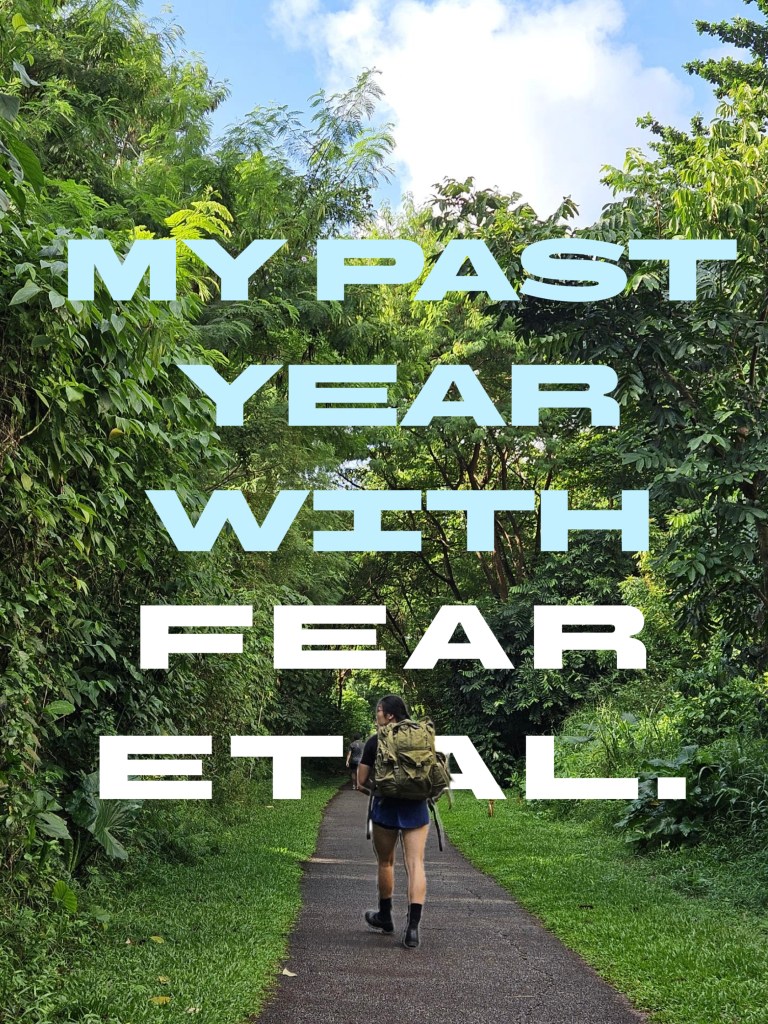
Recently, I’ve attempted a really silly side quest of trying for Ranger Course. For the uninitiated, Ranger Course is one of the hardest courses in the Army, and a mandatory course for the Commandos to pass through to earn their uncommon valour. It is an insanely physical course, but it’s hard too because of its infamous test of mental fortitude with long periods of sleep deprivation, starvation, and is-that-really-not-hazing. People look at me like I’ve gone mad for trying this side quest, partly because only one woman has ever passed out of it, and partly because few people from outside the Commando formation ever attempt the course (much less someone from Artillery who has no business sticking her head into the treacherous politics of the special forces).
And importantly, I’ve failed the selection too, despite my best efforts of preparing for it.
Now that I am comfortably adjusted back to normalcy and the past week of the selection feels like a fever dream, I have to sit with more than 50kg worth of unused gear that I would have to unpack, and the even heavier weight that sits in the pit of my stomach waiting for me to unpack through reflection and writing. This is about dealing with a pretty public failure because by word of mouth, many people would have heard of my amateur attempt at Ranger and how I failed. So, I have to grapple with this unrelenting fear of failure, and also, the more general variety of all types of fear and self-doubt that have plagued me in the process of doing something so out of my comfort zone.
For those interested in a less cerebral reflection on how I have dealt with the company of Fear et al., there’s also a relatively short process documentary (kinda) to aid the long exposition on my preparation, and you get a rough POV of what the side quest had entailed, so feel free to go watch me ramble. But now, let’s jump into the more, in my opinion, critical part of the whole experience – how and why I lived with so much fear over the past few months.
12 months out: Fear of falling behind when life gets in the way
I’ve started the physical preparations about a year ago and have created my own dedicated training programme to strengthen myself to carry up to 27kg of load, and to prevent injury from the heavy stress on my joints. Many of those in my unit then must have witnessed my self-inflicted torture of climbing up and down stairs with my rucksack late at night, or seen a random figure in full uniform sprinting on the unlit running track, or were unfortunate enough to have been dragged in to babysit these extra-curricular exercises to ensure my safety. If you’ve watched the little documentary, it would not have captured just how deep the obsessive training really went. People tended to underestimate how serious I am about this side quest because they don’t see the behind-the-scenes effort put in the moment I decided to do it. I guess that’s a nice clear landmark to start the reflections, because we only really have reason to fear once we start investing, irreversibly, into the decision.
But it could have gone back way, way earlier too. Many people who want to figure out the source of my insanity often ask me why I wanted to try for Ranger, and I’d point it to the instance it was seeded to me as a cadet in 2020, while I was seated on the top bunk bed in the duty room of Delta Wing, struggling to breathe through the fabric mask they had distributed for COVID management. The story begins there, because that was when this crazy, mythical course was first introduced to me, and it was posed as a personal challenge. But it wasn’t until about a year later, deep into my first disillusionment with the Singapore Armed Forces (SAF) that inspired me to write my first reflection piece about being a scholarship holder, that I resolved to myself I would give Ranger a try. I had come to realise that there were many people who would never respect me for a variety of reasons (being a woman, being a scholar etc.) until I’ve proven that I can do something harder than they ever can. And if I care to stay in this organisation, attempting Ranger would be a quick shortcut to gain that respect where reason and intellect fail. And I believe in this reason enough to choose to do something hard.
But in the long term preparation, my greatest fear to overcome was not how hard the course was going to be. I was afraid that I was falling behind all the other people, and that I’d be ill-prepared because I let Life and its unexpected twists become excuses. And Life, and my primary responsibilities, did keep getting in my way. I knew that my peers who would be interested in doing Ranger this year come from places where their primary jobs prioritised and aided their fitness training. Life in Artillery offered no such opportunity, and if I were to be responsible with my job, it would take time away from my fitness. I went on two one-month-long overseas exercises to support live-firing, and those were hard resets on my build-up. I got to a place of six pull-ups, and after those exercises it went back down to four.
I kept showing up even when I really didn’t want to be exercising, because I could hear the metaphorical saxophones getting louder. I felt severely inadequate and way behind everyone else at the starting line. I had no resources to rely on because I came from a place where people told me to run slower so that I don’t hurt their silly little egos, so I had no one except myself and my best efforts and the fitness algorithm on my Instagram feed. I was so sure everyone would be able to tell how unqualified I was the moment they saw me. I was terrified that if I let myself take up those excuses enough, I’d be nowhere near achieving my crazy side quest.
3 months out: Fear of the unknown because all I have are horror stories
For all its problems, the SAF does have its own culture, and history of a great oral tradition. That is how the tales of National Service pass along through generations of Singaporean men and how wisdoms and horror stories get disseminated. The Ranger Course has established its own reputation and repository of crazy anecdotes that only inspire fear in how it degrades, breaks, and tests you. That was all I heard, especially from people who were startled when they knew about my decision to attempt it. The issue with oral traditions is that it often gets bastardised and exaggerated, and as an outsider who did not have anyone who had been through it to talk to and walk me through with tips and tricks to survive the ordeal, I was terrified.
I already specialised in building up monsters in my head, and it did not help that I was only getting information that corroborated those make-belief monsters. It is difficult to write about how visceral the fear of the unknown is, especially to those who had habitually stayed in their comfort zones. I myself would have found it hard to relate a year ago, because I had not really practiced coming out of my comfort zone at all until now. There was no way I would have understood how scared I was just physically entering an unknown space like Pasir Ris or Hendon Camp for the health screening and other administrative matters. I would have to pep talk myself at the gate to try to stop fear-sweating, which always smelled extra acrid and sharp after the ordeal. I always felt like a criminal walking around as the only woman in the camp, and with my very obviously different uniform, and with the google maps pulled upon on my phone. I had to sing-song under my breath when walking around exposed in those foreign camps I do not belong to, as though I was warding off a bad encounter on some dimly lit suspicious back alley at night. The fear of the unknown was deeply irrational.
That was not even touching on the mental component of the fear. I am a mental rehearser, meaning I like to run through all permutations of a possible encounter, come up with an adequate response, and stow that away for quick response if I do encounter a particular situation. The problem with using this method to grapple with the unknown, is that I only visualise the worst possible outcomes. I could only imagine myself getting injured and how I would have to respond to that, or how I would be punished for making a mistake, or how I would be voted out by the brutal peer-appraisal process and I can only do my best to emotionally regulate and not have a breakdown on the spot. The positive self-talk was non-existent.
People never realised that I was so deeply frightened, perhaps because I appeared fearless, and I so desperately wished for a hand of reassurance that didn’t come. It was brutal, and I think I was a very cranky person throughout this period because I was ruled by my worst fears.
1 month out: Fear of letting people down
This was the part of my journey where there were suddenly many people who were helping me. I was no longer steering my own uncertain little boat with no pathfinder or other means of navigation. In quick succession, I got three different sources of help from the Commandos, and got on three separate looong calls, and I had a solid game plan! It was thrilling to have support, but it was also so deeply terrifying. I cannot remember the last time I felt such a deep dread in my bones. I didn’t want it to be such a highly visible attempt, out of the superstition of a birthday wish – if people knew about it, it wouldn’t come true. I wanted to do it first, then let me own actions speak louder than announcing my intentions.
More importantly, I felt like I wasn’t worthy of their help. Despite my best efforts I was still a people pleaser, and I hate, hate, hate the idea of letting people down, especially if I personally fail them despite all the help they have given me. I don’t know when I will ever feel worthy of asking for help. I hope that in confessing this deeply personal fear, I am resonating with something in anyone thinking of trying something difficult, and am convincing you to reach out early for help because the truth is that you will never feel unworthy of support with the right people. More than failing myself, I was so stricken by the possibility that now I might fail other good-hearted people too. I can live with myself if I fail this little side quest, because it’s not that deep really, but I cannot (even till now still haven’t figured out how) live with having people buy in with their emotional and resource investment, and let them down.
I don’t want this to be in any way suggesting I wasn’t grateful for the help. These people have, for no other reason than to help because they can, lent more than their time and resources to support me. This is probably the most memorable and important takeaway from this side quest. It was so touching and unexpected to encounter unconditional goodwill out in the wild, especially after a year of being back in the SAF, an organisation that has disillusioned me out of that idealistic notion. It really confronted me: what are we humans without our gratitude? Even though I have parted ways with this side quest, I cannot ever let go of that immense capacity to be grateful, and to pay it forward. I think both this immense gratitude and crippling fear can coexist at the same time.
In this intensely emotional and physically draining month, I’ve grown both more terrified by the stakes of my side quest, and more confident in my own skills. The spectacle of my side quest also became larger than I expected. People kept telling me how brave I was, when I felt anything but that.
2 weeks out: Fear of being the outsider
Fear has an immense power that makes us freeze up, and withhold our best selves from those around us. This became apparent to me when I went for the pre-course briefing; the first time I actually have to look at the conducting body of Ranger Course, and all my peers, in the eyes in person. We were all sat in a small room, and I found a small corner to become even smaller. Because I knew I didn’t belong there in that room, where everyone knew who’s who, where everyone’s fears were tempered by knowledge, where everyone was side-eyeing me and waiting for me to give them some confirmation that I belonged.
If people have believed me to be confident, to hold space, to find my sure footing in the world, they would not have recognised the version of me consumed by that fear. I was ready to bolt, and had to force myself to breathe through the nausea, and to sit up straight, and to monitor my own body language so that at least I’m not cowering. No amount of networking at some high-power career event, or talking to strangers, or American audacity, could have tided me through. It reminded me that I am so incredibly out of practice when it comes to moving out of my comfort zone. It was awful.
1 day out: Fear of being let down by my own body
The confidence I had built in my own training and in my own physical capacity was something I had nurtured over years of being in competitions. I knew what I was capable of, and I knew how to mentally rehearse myself for high pressure situations. Thank you Kendo for that. But seated there at the physical assessment stations with my back turned to the instructors at 4am, feeling my body still revving up to the sub-optimal performance environment, I was suddenly, for the first time, ensnared by self-doubt. What if my body fails me this time, the one time I need it to really pass?
Knowing the result of my attempt at Ranger, I now can confirm that the self-doubt had planted its nasty roots in me, because I know how my body can fail me even when I have proven to myself before that I could do 10 pull-ups. In this case, that doubt had become deeply gendered. Why couldn’t I just be strong like a guy? I have always struggled with that strange self-loathing that comes with being a woman in a male-dominated field, where your excellence is always limited physically by gender, and people will never hesitate to knock you down a peg by comparing it to a male standard. It is never good enough to be fit, it must always be measured in relation to the “default” of male standard. I knew that I had trained way harder than most guys attempting Ranger just to get those pull-ups, but this newfound fear had completely knocked out the confidence I had built previously in my own training. I am now scared that training isn’t enough to overcome biology.
I feel like this is the most specific type of fear for many women attempting to do scary things. I know, with absolute certainty, that women suffer much better, and we are so much stronger in our minds. But what if mind cannot simply overcome body, and we become our own cages? It’s such an irrational fear, and the ultimate form of self-doubt, because it makes me so frustrated at myself. The past few days, I keep going back to a pull-up bar to do 10 pull-ups, to prove to myself I could do it, to accuse my body for not doing it when it counted, to punish myself again and again by rehearsing where I failed because it is toxic but addictive to keep probing at the bruise. It will take a lot to rehabilitate myself towards gratitude for what my body is capable of, instead of hating it for where it fell short. I don’t know when, if ever, I might finally stop treating exercise as a form of punishment.
But the more complex part of this fear, besides the body dysmorphia, is also the simultaneous hatred of why I even feel the need to be fit like a guy. Coming from a place of self-awareness and maturity, I realise I will not need to be the fittest in any team to be a good team player and to value-add where my strengths are. I know that. I am not in the SAF to serve like a man. There are more than enough guys to do that. And so, I know that this fear in my own limited physical capability is coming from a place of learned and organisational misogyny, and I hate that I let the worst parts of SAF influence me like that. Women don’t have to prove themselves to be men to be valued! However, the uncomfortable realisation is that it is necessary to be a hypocrite! Why did I even feel a need to prove myself and earn people’s respect through Ranger? Because the system requires me to agree to the fundamental assumption that I need to be fit as per a guy’s standard, in order to even sit at the table and open up a discussion about this problem! One must endorse the standard, before one can even begin to break it down.
This is the heart of the fear: I’m afraid that in continuously having this schizophrenic relationship with my body and my gender, I will have to pay such a high price to be acknowledged by a system that only gives a seat to the big boys. In doing so, I lose sight of the problem with this system in the first place, and lose my empathy for weakness, and for the reality of being trapped by our bodies. The last thing I want, is to become punishing towards others when their bodies fail them, all because I claim that “I have done it and so can you”.
Post failure: Fear of failure
People ask me if I would re-attempt Ranger, since I was so close. I tell them honestly: I doubt I could, because as a scholar I am held hostage by the time-and-space requirements of my service to the organisation. Doing side quests is a luxury I doubt I could afford. And I am being genuine in this – I have fully mentally prepared myself for the impossibility of doing this again. I suspect that anyone who tells me that I might have a second chance is only saying that to be nice.
However, when I sit with that even longer, I realise that my response is not a real decision. I simply accepted the circumstances of being a scholar. If I indulged in a thought experiment: say no one got in the way of my choice and practical concerns were not real, would I still do this hard thing again? I don’t get pre-emptive fear of failure, either because I’ve come to terms with its necessity, or because I have failed enough times for exposure therapy to work. But here I am sitting on the left-over side of the selection, confronted by this pretty monumental failure and the gossip and weight of uninformed people’s judgment. If I’m being honest, sitting here, the only thing I’m scared of, is if I have to do this again.
I don’t know if I’d do this again. That feels like a taboo to admit. Knowing what I now know, I’m sure I’d be able to make it through the selection and then some the next time, so it feels like I’m being a quitter. I’m saying this with the failure fresh in mind, especially with the relief from being unburdened from fear so intense. It took so much out of me to do it day in day out, and for now, I really don’t know if I have it in me to build up that courage to surmount those fears once more. I’m glad I got to do something scary, but I’m not eager to commit so soon again because surely there must be more to life than coexisting with debilitating fear.
There is no nice ending to a relatively unsavoury experience, just as how I don’t write this reflection as a playbook for people to navigate their own fears. About a decade ago, some poet came into my Literature class and gave us an exercise to write about an emotion without telling the readers what it was. I don’t think anyone in my class wrote about fear, because what did we as privileged little girls really know about the vocabulary of cowardice and self-doubt? Now though, I’ve spent more than a poem’s length sharing my experiences and hope it meant something to witness another person shaking in their own boots and absolutely pissing themselves with fear. It is to reaffirm that no, being scared is not a sign of weakness, and you should still trust your gut to do it anyways.
My hesitation to reattempt Ranger might seem to be hypocritical with my final landing point: to go out there and do things that scare you. But I hope my reflections is proof that it is possible to do something crazy in spite of the terror it inspires in us. It shouldn’t take away from the fact that doing something terrifying helps put the rest of Life into perspective. It doesn’t subtract from the fact that Life is hard anyways, and sometimes doing something hard of our own choosing is the only way of finding autonomy in our lives. Especially as newly minted adults, we crave our own comfort zone after years of trying to figure out who we are, but if we stay in there for too long, we will forget how to live at all. I will find new ways to push myself to grow; it just might not be Ranger Course again. We only grow our own potential and character in the company of Fear et al.


Leave a comment