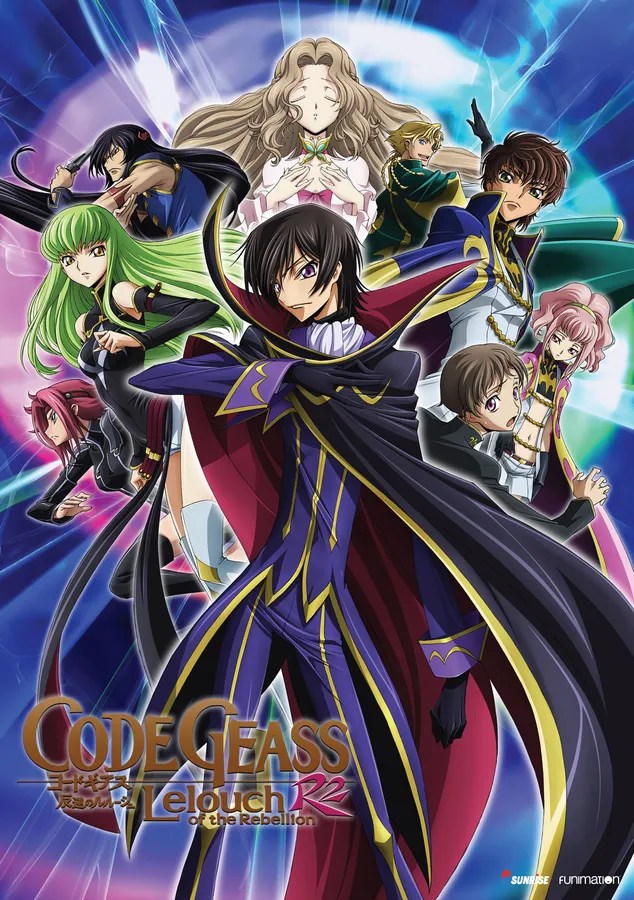
“In the end you’d betray the entire world like it’s betrayed you” (S1 Ep 25). There are a few things that deeply appeals to an angsty self-important teenager, and one of them is this sense of being a misunderstood hero, which was the type of story I would eat right up. I grew up watching anime in the 2010s, in a landscape rife with these sorts of self-important heroes, Code Geass (the two OG seasons on Lelouch of the Rebellion, I have not watched any of the spinoffs) had been especially important and made an indelible impact on me and was one of the first shows that had left me with a sense of hollowness when I finished watching it and made me feel like I was witnessing something really deep, even if I didn’t understand it at that point in time. Now, rewatching Code Geass with more academic understanding than 13-year-old me, I notice some flaws and where the political commentary was a little clumsy. However, I also better understand the value of fiction in clarifying the intersection of power, personal morality, and systemic justice.
The last time I had written about anime was about Legend of the Galactic Heroes, and the analysis was centred upon morality and political regimes (clearly, I have a predisposition towards these topics). Code Geass inspired me to write this reflection because it makes an argument about how power is exercised as an individual and as a collective. Lelouch, our protagonist, represents the thesis – that individual agents that disrupt the system are critical in restoring morality and justice, whereas Suzaku represents the anti-thesis of changing the system progressively and from within. I think these arguments are helpful frames to consider what the appropriate course of action today is in a despondent political regime – is anti-establishment really the antidote? I don’t think Code Geass was trying to assert its practical political relevance, but it was an interesting anime to revisit to dissect the anatomy of power.
The Structures of Power
There are obviously no clean splits between being an anarchic agent or being a part of the system because power structures are often shared across the collective and the individual. I will abbreviate the general plot overview of the anime because that is something readily available on Google. However, I will expand a little on the fictional world that Code Geass takes place in, and how it draws upon our history and politics (and if I am honest, often in quite unsophisticated ways) to show how individual and systemic power affects the characters. It goes without saying, spoiler alert.
A motif that runs throughout the two seasons is that of a chess game. All characters are just pieces on the board, but the interesting thing is that possessing Geass elevates Lelouch to the meta-level of a chess player. Lelouch is introduced to us through a chess match while moving the King – because the king must lead so subordinates follow (S1 Ep 1). This characterisation suggests that individuals are more powerful actors because of an inherent inequality and a rather elitist paradigm of justice. Kings are seen as indispensable, whereas other around him often feel like pieces. For example, in Zero’s plan to use the JLF as distraction, his second-in-command Ohgi doubts his plans because “humans aren’t chess pawns” and he worries that Zero will use them as pawns (S1 Ep 11). Whether Zero truly treats human lives as disposable could be debated, especially since chess also revealed how he lacks a cruel streak. In a chess match with Prince Schneizel, Zero did not bite the King sacrifice when the “emperor would have taken it without hesitation”(S2 Ep 9). Again, this exercise of individual choice and discretion foregrounds the role of agents.
Chess characterises all the power struggles in the anime, and while the king pieces get to assert their own agency, the remaining cast of characters are all pieces in a greater game stuck playing by the rules. The weak have no choice but to play by the system. The strong are able to transcend the game altogether and become the puppeteer (notably the Geass users). CC, the root of the power of Geass, embodies this ability to transcend the game as she often breaks the fourth wall, sometimes speaking to the audience “who do u think I am” as she keeps us in the dark (S1 Ep 7). One of the weakest arcs of the first season with Mao, who establishes his credible threat by winning Lelouch in a chess match (S1 Ep 14). In a rematch later, Lelouch used Geass on himself and worked together with Suzaku, who he trusted fully, to defeat Mao (S1 Ep 16). Everyone is bound to the collective subordination of systems as pieces are bound to the board and rules of chess, but individual agency exist for the privileged to pursue their own strategy as chess players.
The chess board that the anime is set upon also draws from our world to build political systems of oppression. I think that the comparison is meant to highlight the flaws of the systemic approach by demonstrating the ways it can fail. There is the obvious empire of Britannia, which covers 1/3 of the world (S1 Ep 5), alongside other major blocs that the emperor demeans: the EU with their “mob rule” and the Chinese federation with their “lazy dullards from equal economic distribution” (S1 Ep 6). The Britannian empire administers in different numbered colonies – Japan being Area 11, and some place in Middle East that Princess Cornelia conquered is Area 18 – and co-opts locals as “Honorary Britannians” who serve the empire (S1 Ep 6). The physical spaces of occupied territory are divided between the Britannian city and the Japanese settlement and ghettos, as we find out on a train tour of the settlement (S1 Ep 4). The political colonisation and expansion of the Britannian empire seems premised upon the settler colonies of European empires.
The different spheres of power is a commentary on the realities of how systems fail, and is used to juxtapose the necessity for agential change. The Chinese federation, for example, was “like a weak old man with poor quality of life” and forced into a political marriage between Britannian prince Odysseus and the child empress of China (S2 Ep 9). China was also grouped together with the Indian military district, Mongolia and Burma, which felt like a reductive orientalist portrayal. Ultimately, China and EU were insufficient units of organisation because “even systems have limited life spans” and political strife became commonplace (S2 Ep 10). One possible way for Zero to combat the failing systems of governance is to hijack it with his own brilliant creation, the United States of Japan, where it is not language, territory, or blood ties, but heart, which makes one Japanese. That underpinned his plan for the mass exile of all the Zeros onto the iceberg ship as the Japanese nation became a diasporic one without a fixed territory (S2 Ep 8). In addition, Lelouch sets up the UFN, a supra-national structure that awards equality to voting nations proportionate to their population, which he later manipulates as Britannia’s emperor to control the super majority as the most populous country (S2 Ep 22). The idea of a global governance is very much a continuation of a liberal world order dream. There is an oddly civic sense of nationalism different from the ethnic definitions embodied by the rest of the world. This is a strange contradictory amalgamation of our world stitched together, and it shows how an individual like Lelouch is needed to pivot away from failing systems, but the paradox is that even Zero needs to build systems to preserve his power.
I think Code Geass struggles to make clear political arguments because it fundamental misunderstands the political systems it draws inspiration from. For example, Britannia is stylistically inspired by the British empire (it is even in the name), but it also borrows contradictory aspects of the American regime. The emperor wears a wig and looks very British, alongside the echelons of aristocracy with princes, princess, marquis, and dukes. The “pureblood” of Britannian royalty also have purple – a colour historically reserved for the royalty – in their character design, with Lelouch’s eyes and Zero’s outfit also hinting at his royal heritage (S1 Ep 3). So, imagine the incredible whiplash I got when his opening line goes “all men are not created equal”, which is clearly a parody of the US constitution (S1 Ep 6). Lelouch’s declaration to rebuild Japan as a new nation, “broad enough to accept all people, all histories, and ideologies” under the name “the United States of Japan” could be seen as a historical reference to the representative liberalism of America’s independence from British rule (S1 Ep 23). The anime also opens with how the Holy Britannian Empire launched its attack on Japan over underground resources, which is very reminiscent of the oft-cited American pursuit of oil in its expansion and wars in the Middle East (S1 Ep 1).
It seems that the writers were gesturing to the neo-imperial tendencies of United States and perhaps commenting about its military presence and dominance as a global hegemon. However, the British empire and the US empire are not at all similar, and trying to amalgamate them only creates contradictions. In one episode of Suzaku’s class at Ashford academy, they learnt about King Henry IX, and glorifies England for maintaining an absolute monarchy amidst “European waves of parliamentarisation” (S1 Ep 7). It kills my political science and history sensibilities, because first of all, the word doesn’t exist, but even taken at its best the British (King Henry IX is a British King) are a parliamentary democracy, and it’s not true to assume all European countries that become republics have become democratic or have adopted a parliamentary system. Second of all, the tripartite seems to be between Britannia, an absolute monarchy, democracies (in the EU) and the communists (in the Chinese Federation). The comparison is problematic because the imprecise terminology is confusing. Communism is not a political system, and the name “Federation” is closer to the USA political system not at all how EU or China governs themselves.
My criticism extends beyond simply “it’s not realistic”, since I think it undermines the political arguments the anime can make. The inequality that Lelouch might fight in a monarchic or authoritarian empire is in the hereditary privileges of class, whereas if the model is an American one, the inequality is in military and economic might. In the former situation, Lelouch would be a subversive insider, who is royal by blood but takes down the system French Revolution style, whereas in the latter, he is an outsider of the systems of power and has to forge his own advantage with Geass and take down the system Haiti Revolution or nationalist style. All my nit-picky critics is only to say that I think this anime has serious flaws that understandably excludes it from analysis, and that is why I will only scope my discussion to power and morality discussions.
The Hero King
The powers of the individual agent vis-a-vis the collective system changes across the anime, but in general, Lelouch believes justice needs to be championed by an anarchic individual because the system is incapable of being just. Firstly, Lelouch sees how unfair the system is and believes that it cannot be relied upon to provide change. In season 1 episode 9, an Eleven hot dog seller was brutalised by a Britannian, yet Lelouch did not interfere or help the Eleven fight back, because this one day of resistance will incur a sacrifice in the next few days where his business won’t sell anything. Too many things are held hostage by a prejudiced system, and the system rewards people for resisting change. Suzaku was used and abused by his participation in the Britannian forces and treated with disrespect in spite of his excellence in piloting Lancelot and becoming Euphemia’s royal knight. He was still gossiped about in Ashford Academy, still shunned by Britannians like Nina, and his ascension to Euphemia’s private knight was scorned by Cornelia who believes that “discrimination against numbers is Britannia national policy” (S1 Ep 18). Merits had a limit within a corrupt system.
Secondly, systems perpetuate itself, and a failed system breeds chaos and pointless violence. Lelouch started the rebellion with the explicit avoidance of terrorist tactics because he thought that unless he took the “path of righteousness and not fight the people”, Britannia will not be defeated (S1 Ep 1). In the immediate aftermaths of the founding of Black Knights, 7 more terrorist organisations stood up, and “the world is destined for even more chaos” until somebody wins (S1 Ep 5). It is important to note that Zero is not against violence, but against its lack of direction. When Zero returns after his amnesia, he declares that “so long as the strong oppress the weak, the rebellion will continue” (S2 Ep 2). Systemic violence begets violence as a retaliation. In order to really address the problem, individual will must dominate and direct the petty violence and instrumentalise the loss of life to achieve peace. That is the difference between a hero and a system.
Lastly, Lelouch prefers the path of individual heroism because systems are inflexible, whereas agents allow exceptions to be made for the weak. In a collectivist idea of justice, justice serves the average citizens. This excludes the outliers, especially those with disabilities like Nunnally. CC notes that if “survival of the fittest is the most essential rule… Nunally won’t fit in this world”, which is why Zero was born to create a gentler world where an individual can appeal for their own justice (S1 Ep 7). Those who are privileged with above-average resources can abuse their power to oppress others, but it can also very well be an exercise of their exceptionalism and advocate for their disadvantaged loved ones.
Lelouch’s belief in the justice of an individual is also reflected in his love interest, Shirley, who embodies the triumph of individual agency. In episode 13, Shirley acts upon her crush and kissed Lelouch in her moment of weakness from finding out her father’s death, but later apologises for imposing her will on Lelouch and “doing things the wrong way” (S1 Ep 13). When confronted with the true identity of Zero, she takes his gun but ultimately chose not to kill him (S1 Ep 14). This way, she affirms her ability to choose justice – to choose to take responsibility for her wrongs, and to choose to protect Lelouch in spite of what the Britannian society expects to be “right” for her. The greatest turning point came after Shirley’s memory returned after Jeremiah’s Geass cancellation. Instead of harbouring hatred the way she did in season 1, she “forgave Lelouch a long time ago” and understood him. She reclaims her individual power to choose justice when she affirms that “no matter how many times I’m reborn, I will fall in love with you again” and dies in Lelouch’s arms in spite of his use of Geass to compel her to live (S2 Ep 13). It is precisely Shirley, cast as the powerless and helpless maiden, finding her own agency which made Lelouch realise that his Geass was a violation of his model of justice, and he had to “erase the sin of Geass” (S2 Ep 14). Real justice cannot be achieved by the hijacking of an individual’s mind, so both the means and end of Lelouch’s paradigm of justice relies on the triumph of an individual.
This paradigm for justice might seem pretty compelling but the anime does not prescribe it as a silver bullet to the injustices of Code Geass’ world. On the surface, it had convinced even Rolo, Lelouch’s fake younger brother and Geass-wielding assassin, to become a double-agent and protect Lelouch against his training and allegiance to Britannia. However, we are made privy to how Lelouch preyed upon Rolo’s sense of their brotherhood, symbolised by the heart keychain Lelouch gave, while harbouring the explicit intention of throwing Rolo away as punishment for trying to take Nunnally’s place (S2 Ep 4). At the end of his life, Rolo saved Lelouch despite knowing that he had been used his entire life, but Lelouch was the only exploiter who had spent real time and made him human, empowering him with the illusion that “I am doing this of my own free will” (S2 Ep 19). There is something insidious about the allure of the saving powers of an individual, because it could also manipulate those in the orbit of such an individual hero. This hints at the potential for individual power to be abused.
The problems with Lelouch’s approach to justice is that the individual is greatly fallible. “Greatest evil can arise from good” because Lelouch relies on a benevolent dictator model with no safeguard against the abuse of an individual’s concentrated power (S1 Ep 16). Lelouch himself is the greatest victim and suffers the consequences of sacrificing all his loved ones in exchange for his heroism as Zero. Everyone Lelouch has loved – Euphemia, the “first girl [he] loved”, Shirley, and even a sike moment of Nunnally’s death (S1 Ep 23, S2 Ep 18) – all were lost in Zero’s pursuit of justice. The injustices hurt the same hero trying to do something just.
Lelouch’s version of justice had also affected his allies. Lelouch believes in the necessity of sacrifices, and to do justice to the blood already spilled, more blood needs to be spilled (a sunk-cost fallacy type of argument) that Kallen doubts: “is what we’re doing really going to change the world?” (S1 Ep 13). His Geass had also pushed Suzaku to the point of moral failure when the influence of Geass caused him to use the atomic weapon FLEIJA, dirtying Suzaku’s hands for him irredeemably (S2 Ep 18). Lelouch’s willingness to pay the price on behalf of his closest friends condemned him to a flawed version of justice.
Despite the flaw, it is important that Lelouch himself recognises this imperfection and does not make excuses for his own morality. This is perfectly encapsulated in the paradox that Lelouch poses: What would you do when there is an evil you cannot defeat by justice? Do you stain your hands to remove that injustice, or pursue your own justice and surrender to evil? (S2 Ep 4) Evil persists regardless of the choice, since the power to defeat Evil is a sort of Evil burden on himself. When Lady Kaguya proposed to him to be his wife and goddess of victory, he rejects her because he “already made a deal with the devil and cannot have anything to do with a goddess” (S1 Ep 23). As early as his assassination of Clovis, he recognises that “you can’t change the world without dirtying your hands” (S1 Ep 3). Like Princess Cornelia, whose commandership philosophy is that only those “who risk their lives in combat deserve to lead”, Lelouch understands that “the only people who should kill are those prepared to die”, and he is willing to dirty his hands (S1 Ep 7, Ep 8).
This is precisely why Lelouch’s solution, Zero Requiem, feels natural and his version of justice seem compelling. It cannot be anyone else but Lelouch who self-martyrs because only he had cleared the necessary conditions (to borrow his words). It could not have been Euphy, who ordered a massacre while acting under Lelouch’s out-of-control Geass. Hatred was concentrated on Euphemia because she promised a great dream whilst being the symbol of Britannian hypocrisy – “how dare [she] trample on everyone’s hopes” (S1 Ep 23). Her plan for the Special Administrative Zone of Japan only focused on the glamorous side of heroism, and it seemed bound to fail because of the lack of awareness of the great evil an individual can cause. As a corollary punishment, the immense mobilising power of hate is unleashed season 1 finale, where even the side characters were driven to act. Lloyd came out to the front lines to save Suzaku from death at the hands of the Black Knights and Nina came out with her sakuradite bomb to destroy Tokyo (S1 Ep 25). It could not have been Nunnally, who had not proven herself capable of being a worthwhile hero. In the final conversation between Lelouch and Nunnally, Lelouch realised that she planned to make Damocles and the nuclear weapons a symbol of hate so everyone can move forward, which is a similar martyring plan he had, and used Geass so that she will not take the fall (S2 Ep 25). Nunnally had not proposed a heroic alternative to the great burden of hate. The sin of killing was a necessity, but Euphy had already been lost in his previous mistake, and Lelouch was not about to let Nunnally repeat it.
Most importantly, Lelouch’s version of justice required his friendship with Suzaku. Hate had fundamentally changed Suzaku’s philosophy as he was determined to “become a murderer in the skies” to take revenge on Zero (S1 Ep 23). The paradox of being his closest ally yet strongest opponent made Suzaku the most important condition for Lelouch to clear in order to achieve real justice.
The rules of justice
The strongest opposition to Lelouch’s model of justice comes from Suzaku. From the outset, Suzaku opposed Zero’s methods because the ends do not justify the means. The struggle to assert justice is worthless if he cannot do it the right way, which explains why he insisted on standing for his unfair trial because “those are the rules” of the game (S1 Ep 4). Suzaku believed the Black Knights should join the police if they really cared about justice, otherwise it is indulgent self-satisfaction (S1 Ep 9). He repeatedly condemns Zero across his campaigns, because of the hypocrisy of Zero using people then acting like a judge and believes that it is better to die and self-destruct than to break more rules (S1 Ep 13, Ep 18). His belief is potentially rooted in his self-hatred and guilt of killing his own father. The pocket watch that was a memento from his father was stopped at 2:34, his time of death, the moment at which Suzaku’s felt like his life was suspended ad infinitum for him to atone endlessly (S1 Ep 16). Suzaku insists that systemic reform is more just than vigilantism, perhaps because he had made that mistake in his childhood.
In the absence of a clear moral philosophy that defines what change in the “right” way means, Suzaku relies upon external structures to provide accountability. That is why works within the political and moral systems around him. After he defeats Lelouch and uncovers his identity, he brings him to the Britannian emperor and is rewarded by becoming a knight of rounds (S2 Ep 2). Suzaku wants to become Knight of One to get an Area to himself and use it to revive Japan, and his desire to become powerful is so that “he will never lose anyone else” (S2 Ep 5). The irony of that is the fact that he has to sacrifice Lelouch and lose one of his closest friends. The outsourcing of moral struggle to an existing system caused this hypocrisy, but at least the systemic rewards provide a stable form of power.
There are some merits to Suzaku’s world view, seeing how Nunnally, who is Lelouch’s North Star, had sided with him and condemned Zero’s world view. Firstly, systemic justice creates common interest and strives for a very consequentialist success, which does the most good for the most number of people. A system’s success is tied to its parts, and thus it cannot betray and dispose of its component. The Black Knights felt like they were nothing but pawns and Kallen felt exploited after Schneizel revealed Zero’s Britannian Prince identity and possession of Geass (S2 Ep 19). In contrast, Suzaku found some sort of duty amongst his Knight of Rounds, even if it’s not friendship, built upon their common honour. Their loyalty is rewarded, and by reinforcing the emperor’s version of justice, even an Eleven like Suzaku could benefit from the empire.
Secondly, systemic justice satisfies human’s desire to be a social creature and so creates collective ownership over the outcome. When Nunnally tries to convince Zero to take give the special administrative zone another chance, she pleads “if you’re human, you will try again” (S2 Ep 5). There is something human about the need to collaborate to create change, and trying to bypass the system is an anti-social behaviour that erodes people’s sense of ownership over the outcome. Take the Black Knights for example. After they had their first crisis at the end of season 1 when Zero disappears. Short of CC, no one else was able to continue the effective resistance against the empire because they lost their figurehead and their sense of purpose. On the other hand, the season 2 arc saw the Black Knights expanding their vision of a resistance to include the Chinese Federation, the Kyoto factions of resistance, and eventually members of the UFN. Lelouch, in a surprising turn, built a system to perpetuate its own success in his absence (while he goes MIA on his visits to the world of Geass).
Suzaku is a foil to Lelouch, just as how his love-interest Princess Euphemia fully embodied the potential of a systemic reform. Euphy first realised her ability to shape the system when she was tasked with picking out the artwork winners for art week and had to choose between the Eleven’s painting she really liked, and the aristocrat’s nationalistic painting (S1 Ep 17). She further acts upon this in her radical choice of knight and declares her love over an open channel for Suzaku (S1 Ep 20). By leveraging upon her own privileges within the system, Euphy willingly positions herself for the weak. For example, she reveals her identity for the commoners during the hostage situation and his earned Nina’s lifelong admiration (S1 Ep 8). She also offered the first genuinely radical and philosophically sound opposition to Zero’s plans by proposing a specially administered zone to allow for an equal world for Japanese (S1 Ep 21). Instead of tearing down the system, she became a Princess Diana sort of figure, being for the people and using her privilege in the system to help those weaker. Euphemia proves that systems do not have to be used for oppression.
The greatest weakness in Suzaku’s collective version of justice is its hypocrisy. Despite being reliant on a system for justice, he pleads his own exception to make his world view work. He does not rise through the ranks of normal Elevens and instead jumps to piloting Lancelot, which rewarded individual uniqueness and star power over the other generic Knightmares. He benefited from the support of Lloyd, who was an eccentric maverick very much outside of the norms of Britannian high society. The princess of Britannian also quite literally fell from the sky and bestowed upon him the protection of royalty. In other words, he is not testament to the success achieved from rising through the system, but to being able to bypass it. When Suzaku was asked why he was in the military despite hating people dying, he responded that “I’m in the military so people don’t have to die”, and was gently rebutted that “this sort of contradictions will get you killed someday” (S1 Ep 11). How much of Suzaku’s world view actually is feasible without his ability to make individual exceptions?
Suzaku is not the titular character, and the weaknesses of his paradigm of justice are obvious. However, it has indisputable lasting power, and his conception of justice cannot be secondary to understanding the show’s ultimate claim. He quite literally outliving Lelouch, and being the successor of Zero protected by the divine hopes of Geass which compelled him to live and by interventions like Zero saving him with energy chargers in a fight (S1 Ep 19, Ep 20). From then on, he cannot simply sacrifice himself as atonement, but must live with the curse (or wish, depending on how you frame it) Lelouch placed on him.
Synthesis of the two paradigms
Fiction does not seek to predict the future of our reality, although I am sure Lelouch would have no doubt enjoyed the platform. However, in today’s world where it feels like we need a little guidance to overcome political depression, there are a few important takeaways from the two contrasting paradigms of justice.
I hesitate to say that Lelouch’s brand of an anarchic hero is what we need in when trust is bankrupt and politics feels like a joke that writes itself. Adopting Lelouch’s model would mean adopting Lelouch’s intense self-hatred from his disdain of the aristocracy, and that self-hatred is unproductive for today’s climate of despair. Lelouch’s greatest disdain is towards the very blood in his veins – when he infiltrated Prince Clovis’ ship, he reveals his identity as Lelouch Vi Britannia, and how the prince of the empire hates the Britannian system so much he is willing to dismantle it (S1 Ep 2). His hatred stems from the cruelty of shown towards him when the emperor trivialised the death of his mother, Lady Marianne, and dismissed him since he has “no time to babysit a child” and has “no use for weaklings” (S1 Ep 7). This self-hatred could have created a vastly different Zero, as we see him break down under the stress and abused his Geass to humiliate a couple of Britannians, turned to the drug Refrain, and asked Kallen to comfort him with sex (S2 Ep 6). He could have shared a similar twisted fate as Mao, another Geass user. CC’s attempt to raise Mao had corrupted him and he tracks her down and shoots her, fantasises about a deranged future where he buys a house in Australia to spend time with the portions of her that he chainsaws up (S1 Ep 15). Mao’s hatred of his own Geass, and loss of control in his love for CC, highlights how it is possible for this self-hatred to cause love to turn into a destructive force. As such, I do not think that Lelouch’s model as its own stand alone is the best prescription for reality.
Like all good cop-out answers, I think the right prescription lies between Lelouch’s self-sacrifice, and Suzaku’s hypocritical sense of justice. The anime had positioned these two as opposites but forced them to work together. Most of the cast’s lives take place on Ashford Academy, and the student council became a space where friendship could lead to the synthesis of ideas. The school festivals are especially important. In season 1, Nunnally, Lelouch and Euphemia hung out together for the last time, and in season 2, Lelouch got together with the student council to set off fireworks together in a moment of doubt (S1 Ep 21, S2 Ep 6). Not only does this allow the characters to be high school students for a moment in the chaotic world they live in, it also foregrounds the importance of synthesis.
I think it is a little cliché to say that the power of love and friendship solves everything, but Code Geass gestures towards this important means to synthesise the paradigms of justice. For Suzaku, these entanglements with Lelouch in Ashford, whilst suspecting his identity as Zero, had been a touch of happiness, which, like glass, requires a change in perspective to notice its presence (S2 Ep 6). Justice, like happiness, perhaps requires a different perspective to better appreciate. Suzaku had his mind changed by Lelouch, and Lelouch learnt to doubt his own plans of revenge. Love and “passions have the power to change the world”, as the anime cast learns from Xing Ke’s rescue of the Chinese empress (S2 Ep 11). CC, the powerful immortal witch, draws her power from a contract with the previous witch to make people love her (S2 Ep 15). This love extends to romantic partners, but also to platonic love.
I would argue that in order for real justice to be achieved, friendship and love is necessary as a mechanism of synthesis because it keeps power accountable. All good ideas can perpetuate its own noxious legacy if it remains blinded to its own faults and fails to adapt. Genuine friendship and love challenge these ideas to be better versions of itself. When Lelouch, who thought he had lost everything, asks the reverted child-like CC what she does when she hurts on the inside, she replies that she turns to friends. As a result, Lelouch calls and begs Suzaku to protect Nunally as the only one he could ask despite being ideological nemesis (S2 Ep 16). This friendship extends both ways. When Zero’s mask was stolen mask by a cat, it seems symbolic that was Suzaku who found it, and in return he obtained social acceptance amongst the Britannian Ashford elites (S1 Ep 6). The two worked together again to save Nunnally from Mao’s kidnapping (S1 Ep 16). Finally, the entire premise of Zero Requiem worked because Lelouch and Suzaku were finally working together – Lelouch pursuing his own individual heroism to its end, and Suzaku working to be part of a system that liberates the world from the great hatred towards Lelouch. Love does not merely provide rhetorical or symbolic power. It has tangible impacts on the decisions, alliances, and outcome of justice in the anime. Friendships and love forged in the slice-of-life moments goes beyond the feel good fluff.
The failures of the Emperor Charles and Prince Schneizel provides a foil and shows how their versions of justice quickly deteriorates without an equal who loves them and challenges them. Charles was stuck on preserving the past (S2 Ep 24). His idea of a just world is tied to a childhood promise he made with his brother VV to smash the world of lies (S2 Ep 14). The Ragnarok connection intended to discard the masks of deceit, which sounds theoretically good, until Charles killed VV for lying to him about killing his wife (S2 Ep 20). Losing VV and Marianne (even if it was a staged death) left Charles alone and unchecked, and bankrupted the “world without lies” of all its potential. The inherent contradiction that Charles identified in his debate with Lelouch – “why do you lie when you want other to understand you” – pushed Lelouch to come to his senses and realise that he will walk the same trajectory as his father if he does not enlist support from people who understand him (S2 Ep 15). The friendship he forged broke through his isolated echo chamber with the Black Knights and prevented his world from stagnating.
Schneizel’s world view seems less ideologically coherent, but what I can say is that at his core Schneizel’s justice is barren and unpopulated. He has no close aides or real friendship with his siblings, unlike Cornelia and Euphy, and Lelouch and Nunnally. He believes in justice being a system backed by force – in this case the nuclear weapon FLEIJA – and is willing to lose 1-2 billion lives for permanent peace (S2 Ep 23). Schneizel abandons everyone and only picks a fight he cannot lose – his sisters Cornelia and Nunally after using them to obtain FLEIJA, his subordinates after they fought the battles against the Black Knights for him (S2 Ep 24). His motivation is unclear – why does he want that absolute power then? – but what is clear is that justice (or peace?) without love cannot be accountable.
Where does that leave us in today’s world? I doubt we would be able to see a martyr like Lelouch parade about and broadcast his dictatorship, only for Suzaku figure to kill him so that the world will gather “not through force of arms but around table for discussion” (S2 Ep 25). That seems like a heavy dose of copium and psychological tricks to deny the politically depressing reality. We might even feel as though the fortress Damocles is hovering above us — just as in the legend, the sword hangs above the king’s head by a single horsehair (S2 Ep 22). “Geass is like a wish — a request to someone to empower you achieve what you can’t on your own” (S2 Ep 25). We do not have such a luxury of fantasy to wish for someone to save us. The fundamental lesson I take away from Code Geass, is to learn to strive for that version of justice ourselves. In season 2, Lelouch makes a comeback from his amnesia – “if it’s wrong to be powerless, does having power make you right?” (S2 Ep 1). He probably would say no and claim that being right is what gives him power. Like Plato’s philosopher king, one must choose to be right, and act on the burden to ensure that power does not slip into the grasps of the dangerous and undeserving.
At the UFN meeting, Lady Kaguya had declared that “dignity is needed to govern the world”. Lelouch, as Zero, laughs at that high-mindedness, and posits his own reply “willingness to destroy the world and yourself” is required to govern the world (S2 Ep 22). Teenage me would have thought that was really cool. Now, I think Lelouch’s death was not meant to glorify his actions, but to caution us against falling into the same trap. Rewatching Code Geass recently had made me realise how pertinent self-awareness is if I wish to do something important in my life and to achieve a form of justice I can be proud of.


Leave a comment