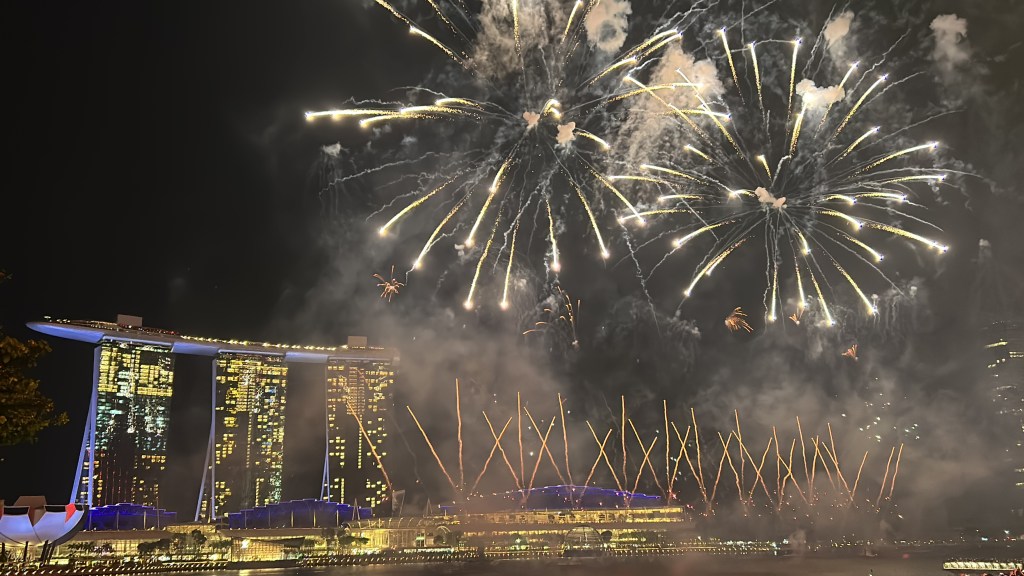
August 9, and it’s Singapore’s birthday again. This was the first year that I was in some capacity helping out with the National Day Celebrations, potentially explaining my enthusiasm in watching this year’s livestream. I am an amateur watcher, no different from when I was 11 as a P5 student at the NE show, and when I was 18 watching a preview as part of Army’s recruitment programme for me. However, while watching this year’s celebrations, I kept hearing a voice with an American accent at the back of my mind: THIS IS IT (the voice chimes) THIS IS THE PERFECT CARICATURE FOR THE SOFT AUTHORITARIANISM IN SINGAPORE. THIS IS WHY SINGAPORE IS NOT INVITED TO THE OH-SO-COVETED SPOT BESIDE THE U.S. AT DEMOCRACY SUMMITS!
Sometimes it is easy to forget that the scale of Singapore’s National Day Parade (NDP) is abnormal in the world — perhaps 4th of July celebrations might come close, but even then, no one has an annual NDP theme song that almost every citizen will know. NDP costs the government around $20 million to run annually; China’s massive parade celebrations might outdo NDP, but they have controlled frequencies of only once a decade; and the UK’s rare coronation for a new monarch costs between £50 – 100 million. These are only financial ways of quantifying Singapore’ unique commitment to our National Day. Qualitatively, I think NDP is akin to a football game or a famous musician’s concert — everyone writhes to the same chants and songs, dresses in the same colour-coded ways, and becomes a singular organism where differences are erased and we come close to unity as humanity.
The difference between NDP and a football match, however, is that Western-educated intellectuals have a deeply rooted discomfort when it comes to fanaticism towards the state. Patriotism is seen as adjacent to the right-wing ideology, especially in America. For the uninitiated, it is easy for the world to misinterpret Singapore’s NDP as militaristic (because of the high visibility of the Army as the main organiser) and authoritarian (mass rituals that seem to brainwash everyone into positive feelings towards the nation? Very Baron Harkonnen core). This perspective on NDP forced me to reflect upon Singapore’s unique brand of patriotism. I still strongly feel that this is a sense of belonging that is no different than a person’s attachment to Taylor Swift, or a football fan’s dedication to their football club. I think it’s a brand of football team patriotism (or at least that’s how I think of it), with a hibernating sense of belonging that is only triggered by events and is repeated so habitually in our lives that unknowingly it becomes deeply entrenched in our sense of self. It’s really not the insidious caricature of an authoritarian state and here’s some critical reasons why:
Going-to-Malaysia problem
Some Singaporeans gripe about the pragmatism of Singaporeans who escape the country to exploit the public holiday and the favourable exchange rate to enjoy themselves for a cheaper price. I myself am guilty of this, having went to Malaysia for a better part of the day and only making it back in time to watch the livestream, perhaps to ease the guilty of leaving Singapore on her birthday. What academia or traditional political indicators fail to capture is this underlying pragmatism rooted in our patriotism. Just like how some fair-weather football fans are supportive only when their team is winning, I think that there is an unmistakable conditionality to Singaporean’s love for Singapore. So long as we maintain the cushy stability, remain economically successful, be convenient to love, we will continue to stay committed to NDPs and the investment in our nation. In some paradoxical way, this is a stronger foundation for a democratic social compact — it is hard to abuse power and turn into the big bad authoritarian state when Singaporean’s loyalty and support is conditional on good performance.
I have always struggled to determine whether this is necessarily a criticism. A survey by Deloitte concluded that most football fans are partially interested (22%) and big-event fans (21%), and team switching during a bad season isn’t uncommon. It is not unique to Singaporeans to be somewhat pragmatic about our passions, and that lukewarm feelings of belonging is the norm. In fact, I think that the red white and patriotic posts that flood social media are startling considering how they are the rare posts from some people who just crawled out of their social media caves this one time of the year. There’s no state directives, no mass-controlled social media campaign, but it stems from the very lukewarm and event-centric love that Singaporeans harbour.
There’s also some positives about Singaporeans flooding to Malaysia for the public holiday. I think it signifies a connectedness of civil relationships across the straits, and that there is mutual goodwill at the most mundane level (regardless of what state-on-state relationships look like). The absence of territoriality and other-ness in Singapore’s sense of patriotism is, I think, pretty convincing evidence that these nation-building projects are benign and not insidious tools of the state.
Platforming creativity
Dictators attack Art. That seems to be wisdom validated by history and by our imaginations in fiction. Creativity and artistic expression are seen as anarchic and an escape from control. Perhaps ironically, the late Lee Kuan Yew’s quote “Poetry is a luxury we cannot afford” is often misinterpreted as further evidence of Singapore’s authoritarian nature. If anti-creativity is authoritarian, I would thus suggest that the platform NDP offers for local artists is evidence that such accusations are unfair.
This year’s NDP featured 12 artists and 3000 performers, and there is an effort to engage performing arts groups, cellist, dancers, and many other to make a debut on a national platform. I have always been pretty skeptical of Singapore’s creative scene, and I will always be skeptical of top-down efforts to encourage artistic developments, but I think it would be unfair of me to discount these efforts to platform art. I have no insights from the behind-the-scenes and cannot comment on whether these creative efforts have been sanitised by bureaucracy, but the fact that the military parade segment is not the only highlight of NDP, the fact that the NDP organising committee is bigger than just military personnel and the Chairman and Creative Director positions have creatives like Steven Ong and Brian Gothong Tan, seem like admirable efforts to commit to an artistic vision. Just as singers who open American Football games with the ‘Star-spangled banner’ can make or break their careers with the platform, I think NDP functions in a similar high visibility way for creativity in Singapore to take flight.
Our home, our echo-chambers
As the stunning fireworks that cap off NDP bloom in the sky above Singapore’s Central Business District (CBD), I think back to how all my international friends ask me whether Singapore was really as luxurious as portrayed in Crazy Rich Asians. The CBD area is iconic and an integral part of Singapore’s image, but the light and sounds only echo between the glass towers of wealth and a skewed demographic of Singapore. An average Singaporean’s Singapore is not as picturesque as the glittering views of tourism. The literal echo-chamber of the location of NDP celebrations mirror the ways the caricature of our nation is but a small slice of reality that becomes an academic stereotype.
I would hazard a guess that many people in Singapore hardly bat an eye at NDP — they don’t wave the flag, they don’t tune into NDP even on livestream, they continue working especially if they’re working in public transportation or healthcare or service sectors or other operations that would inconvenience us if it was halted. To imagine that Singapore stands still and turns into a mass brainwashing day on NDP is to privilege one version of Singapore’s narrative and neglect these other people. Bringing NDP to the heartlands, and having public engagements and volunteering work are steps in the right direction, but many are still marginalised. The story of immigration, for example, is one that I am very familiar with as a second generation citizen. My parents hardly care about this celebration because they live in the limbo of identities. The NDP celebrations itself, though deliberate with being multi-racial and multi-lingual, feels awkward with how little Singaporean Chinese know the Bahasa and Tamil songs. The fanatic, true-brew Singaporean who lotteries for NDP tickets, who sings their hearts out with love songs for the nation, exists, but it would be our own mistake if we let this image hijack our understanding of Singaporean’s patriotism within this echo chamber.
My well wishes
My own love for Singapore falls into the category of casual football patriotism. I hardly keep in touch with Singapore’s going-ons while I study in America, I did not grow up with the experience of watching NDP, and I still struggle to order some Singaporean dishes “authentically”. However, only upon deeper reflection do I realise that the lacklustre demonstration of my patriotism is not equivalent to the importance I give to Singapore in my heart. Being Singaporean is so deeply engrained in my sense of self out of the many cumulative small habits. I wish that all my international friends will get a chance to visit — because I am excited to show them my home. I wish that when we say we will defend “our way of life” it means making sure that many generations down, children will still be able to go to a hawker centre themselves and order a bowl of laksa or some other dishes that I love.
Importantly, my love for Singapore manifests in the ways I wish the best for her by seeing the ways to improve what we have. Perhaps many Singaporeans feel the same way, and that is why we complain a lot. The love I have becomes clearer when looking at it from outside with the coolness of a partially interested football fan, when I can stand to listen to slander and voice my own criticisms. I mean, NDP itself is a historically contentious topic with boycotts and condemnation of the “waste of public money”. If we lose the ability to contest decisions, perhaps we would not have such high standards for NDP today.
Perhaps I am writing this as the impending return to the U.S. looms in the horizon, and I feel particularly defensive about the way Western media and academics portray my home as a caricature of authoritarian exceptionalism. My ability to participate in NDP casually can coexist with people who care deeply about this annual affair, which is testament to the sort of liberties that exist in Singapore, no matter how limited it might seem to the West. Perhaps this issue really isn’t that deep and maybe I should just turn my brain off an enjoy the NDP livestream next year. Whatever it is, I will always have my heart here, where I know I must be, where I belong.


Leave a comment