
In college, I picked up two new languages, and I suppose that makes me officially a polyglot (of dubious fluency). I grew up speaking Chinese to my family, but I think, dream, and express myself the most freely in English; I am now 1 year into learning Hebrew, and a couple months into formally learning Japanese after years of exposure to the language via watching anime and doing kendo. I don’t know if Singlish counts as an additional language, but I know some of my friends would consider it an English dialect, a linguistic paradox of a blend of languages spoken in Singapore.
I think learning new languages as an adult is really satisfying and tickles a part of my brain that other forms of learning don’t. But the more I learn, the more reflections I have about language learning and what it means to communicate. I thought I would challenge myself by writing a little reflection about it, in all the languages I do know, and in descending orders of mastery (well, inevitably English will be the longest and most eloquent version).
Let’s start with the two languages that I consider myself a native speaker – English and Chinese. I will say this time and time again, but I am so glad that I grew up with these two languages because it seems unimaginable to have to learn either of them from scratch. I am so glad that there is a natural intuition for the language, and I don’t have to think too hard about using them. The exceptions and vocabulary would have been challenging to grasp as an adult learner. I say this now, although to be clear, I have always been grammatically challenged in English and only really got comfortable with it when I started a blog and practiced connecting the language with my thoughts. My primary school teachers would probably be surprised I am as much of a humanities person as I am today, given how poorly I had mastered English with them.
My mother is a Chinese language teacher, and did her undergraduate degree in Chinese Literature, and I think that gave her the prescient to value my bilingual education in Singapore. She never really imposed Chinese upon my brother and I, nor pegged her pride as a Chinese teacher to how good (or bad) our Chinese is. And both of us didn’t do very well under the Singaporean education system’s way of teaching Chinese (bookmark this because I have many opinions about this). She did encourage me to take a bilingual bicultural route in my education, and so from secondary school onwards I learnt about China in Chinese and had to read and write in a strictly academic way. Fundamentally, this shaped my relationship with Chinese. In my mind, it has only two functions: the deeply intimate language I use with my family, or the other extreme of the entirely academic lingo used in research papers and essays. I find it off-putting when strangers, seeing that I look Chinese, approach me with Chinese as a default. Firstly, because Chinese is not the language I use for schmoozing and being witty and silver-tongued, and secondly, because I don’t like this implied sense of familiarity when they use this intimate language with me.
My mother is effectively monolingual and dreams only in Chinese. Her love, and the most dextrous tool she has to express it with, is Chinese. Mine is decidedly English. I can write poems in English, and be clever, and say exactly what I mean, but she never really learned English beyond the broken secondary school level taught in China. I think this is where language creates heartbreak, because I can’t go back to a time where we really communicated in my mother tongue. I used to write poems to process our difficult relationship, and I gifted it to her for Mother’s Day a few years ago to express my gratitude and love for her. That went awfully, because all the beauty of English poetry, and the nuances of my complicated love for her, were lost, and she interpreted it as a manifesto against her. I want to say that I am bilingual in these two languages, but sometimes I feel that even that is a stretch. I don’t believe that you have mastered a language until you can flirt and argue in it.
Language diversity
Growing up, I felt that glamourising polyglots was a big thing. It felt like an extension of the Singapore culture of needing to get more certificates, collect more achievements, add more to the CVs, and language eventually became another gold start to pin to our proud chests to distinguish ourselves from all the other bilingual plebs.
However, when I look back on it now, I felt like these polyglots were just people who spoke 7 different languages, but none of the languages came from different time zones. Not to say that it’s not impressive, but I don’t think that degree of idolisation is unfairly given to them when the non-Western people around me who are speaking 3 different dialects, Malay, English, and their own unique blend of regional languages are looked down upon. We think of polyglots as some white person who is cosmopolitan and well-travelled, not the uncle who sells us chicken rice in the hawker centre, or the kid who sits in Ben Thanh Market cajoling tourists from all over the world.
Take a look at these very interesting language visualisations. Notice how the Indo-European only has 176 languages (as compared to Niger-Congo or Austronesian language families) but houses the 7 most spoken languages? We have colonialism to thank for that. None of them even come close to the number of Chinese speakers. The language we value intuitively is very different from the reality.
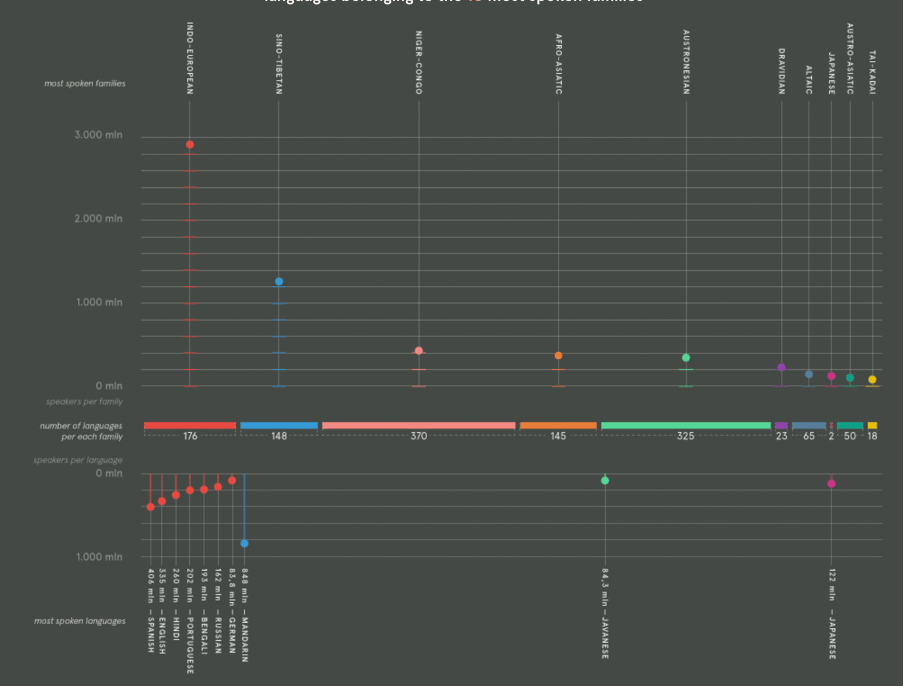
This second figure would be a better visualisation of just how massive the proportion of Chinese speakers are in the world. It is also a great illustration of how the diversity in dialects gets erased and grouped all under “Chinese”. You cannot tell me that if romance languages count as individual languages, Cantonese and Mandarin belong in the same category…

The point of this discussion is to highlight the inequalities in language recognition. There’s a whole debate to be had about this inequality manifesting in AI and language learning. Low resource languages get left in the dust, and eventually this squeezes the diversity from language families. Learning so many new languages made me acutely aware of the difficulty of acquiring them, and it feels like injustice that many people are not getting recognised for this because of a heavy bias in the world’s language infrastructure.
The architecture of language learning
Speaking of language infrastructure, learning two new languages here in the US had changed the way I viewed language learning. Looking back, there’s some critical differences that made the Singaporean experience less enjoyable. There were options for picking up a Third language in our teenage years, but the architecture of language learning in Singapore does not set us up for success. I personally have not taken a Third Language class, but the special brand of elitism of having to accumulate these additional skills resulted in many of my friends having experiences with it.
Firstly, treating it as “Third Lang” creates an attitude where language learning is seen as a tertiary concern after the rest of our academic classes. On top of that, having to physically travel to language centres instead of having the classes at schools makes it easier to de-prioritise it. This all creates a space of exception for the new language, when in fact language learning requires integration. It’s not good enough to touch a language every once in a while; most of the learning happens in the black box of our minds when we interface with it consistently. My Hebrew and Japanese classes are daily routines, and their workload are accounted for in my schedules, not as an additional thing I only do when I have the capacity to.
Secondly, I think that another important, but less tangible, aspect in the architecture of learning is the encouragement of mistakes. Language learning only happens when we are comfortable with making mistakes or sounding stupid because we say the wrong thing. Singapore, however, is not known for its tolerance of mistakes. It makes for a very unproductive environment where mistakes hurt our one measure of language competence: test scores. I don’t think I would have enjoyed learning Hebrew and Japanese, or even be able to take two languages at once, if that was the kind of environment for learning.
More pressing problems with our language learning infrastructure are in how we teach mother tongue. I learned Chinese, and my mother was a Chinese teacher from the Ministry of Education, so between us I think we have a pretty good perspective on the Chinese curriculum itself. There’s a whole other can of worms regarding Bahasa, Tamil and Hindi, but I only heard about the under-resourcing of these languages, and so I will not pretend to apply the Chinese experience as universally Singaporean.
Let me start with the positive: I think Singapore’s Chinese teachers work very hard to return timely feedback on our written work. I think this closed feedback loop is critical to learning from our mistakes, and so kudos to them for being on top of it. However, the biggest gripe I have is with the system’s fundamental neglect of the joys of communication. Despite a majority ethnic Chinese society, many people don’t speak Chinese at home, which erodes the assumption that this is a “mother tongue” of Singaporeans. Therefore, fostering that joy to incentivise children to learn Chinese with their peers is paramount. Instead, this joy is killed by a system that is test-heavy and conversation-light, which makes written Chinese seem more and obscures the point that language is fun because it is also verbal communication with others. The only spoken portions in our education are in the very early years of primary school where we learnt pronunciation, and later in the oral examinations. Not surprisingly, testing removes all the fun of conversation. For those students who don’t have family as a resource to speak Chinese with, all they do is listen mutely to teachers lecture in class, write essays and take reading comprehension exams, and stress about the exceptional times they are expected to converse fluently during the oral exams. No wonder people don’t enjoy Chinese as a language.
Even within the non-spoken portion of my Chinese education, I didn’t enjoy the demand of form over substance. I will caveat this with an acknowledgement that I’ve heard new language syllabus trying to address this issue, and these are my opinions from a generation before this reform. In primary school we learn only to write descriptive narratives, which is important in communication and establishes basic language mastery. In upper levels however, argumentative essays and nuanced comprehension passages were meant to lead us towards thinking critically. My mother believes that students who fail in Chinese fail because they have no critical thinking. The language is simply an extension of the way to see the world. By treating Chinese as fundamentally different from English, most students fail to see that connection between what they learn in each class, and Chinese remains an underutilised muscle. Contrary to what the Singapore system made me feel, language is not just about whether we write the correct email formats or know the correct vocabulary (I deeply hated those email essays we had to write in secondary school). I didn’t perform in Chinese examinations because I felt like I was being graded as though Chinese was a science, and there were “correct” answers to method of thinking.
Moving beyond the formal education though, I think another big problem I have with learning Chinese in Singapore is the fundamental flaws in our long-held myths of “effective bilingualism”. I think that bilingualism is a very elitist conception of language learning, and it fails to capture the diversity of Singapore’s language environment. Even before bilingualism, many Singaporeans had to know various dialects and Malay to work within our population. Pruning the environment into the neat and recognisable categories fails to recognise the strengths of the older generation, who are adept at slipping in and out of many languages to communicate effectively.
Part of this bilingual myth is a legacy of Lee Kuan Yew’s policy, on one hand to “speak good English”, and on the other to formalise and co-opt mother tongue, such as with Chinese in the Special Assistance Schools scheme. Standardise and unify. His policy of bilingualism is rooted in practicality, as he reflects in his memoir: “If we were monolingual in our mother tongues, we would not make a living. Becoming monolingual in English would have been a setback. We would have lost our cultural identity, that quiet confidence about ourselves and our place in the world.” No doubt this policy had afforded many Singaporeans an edge in global competition and many appreciate it (don’t get me wrong, as do I), but I think it is a centre piece that props up elitism in Singapore. Higher Mother Tongue becomes a utilitarian way of gaining yet another edge over other Singaporeans. There are more collectibles in our rat race. The Singaporean elite now needs to be effectively bilingual.
Now that there is a “correct” way to speak English and our mother tongues, Singlish and other dialects are looked down upon. The arbiter of “correctness” comes from a very unforgiving social context. The Hokkien Soldier is seen as a backwards relic of the past in the Singapore Armed Forces (SAF), but the language hierarchy he represents is far from dead. It is really obvious from my time in the Army that “good English” is a marker of elitism that makes you stick out like a sore thumb, and an average Singaporean speak more freely in their mother tongue or with Singlish slang. I’m not lamenting the existence of standards that differentiate good and bad language competency. I’m suggesting that it’s important to not treat language that fall short of correctness as undesirable. They have their rightful place in social use. In Hebrew, the complex grammatical rules were criticised as a means of gatekeeping education, keeping the masses uneducated, and shunning social groups. In Japanese, using kanji was a way to elevate the educated above the masses. It is an integral part of any language’s history to use its power to exclude, and I see this act of learning Chinese in Singapore as a part of this history.
This is starting to get into ranting territory, but I call it the myth of bilingualism because I think it is fundamentally also kind of bullshit. The “bilingual Singaporeans” who benefited from Lee’s policies are firstly, a small group of elites few and far between, and secondly, more often than not quite awful at their mother tongue. It seems to me that the elite circles of Singaporeans are mostly people who aren’t effectively bilingual beyond in name. This IPS survey in 2018 found that “across all ethnic groups, reported heritage language proficiencies have significantly declined over the past five years”. Amongst Chinese speakers, the proportion of university-educated respondents who reported bilingual proficiency dipped from 48% to 37%, and the proportion of those who speak only English “very well” grew significantly from 28% to 41% from 2013 to 2018. Skim the report, I think it’s very interesting stuff, although I think the survey methodology requires some scepticism of self-reported perceptions of language competency.
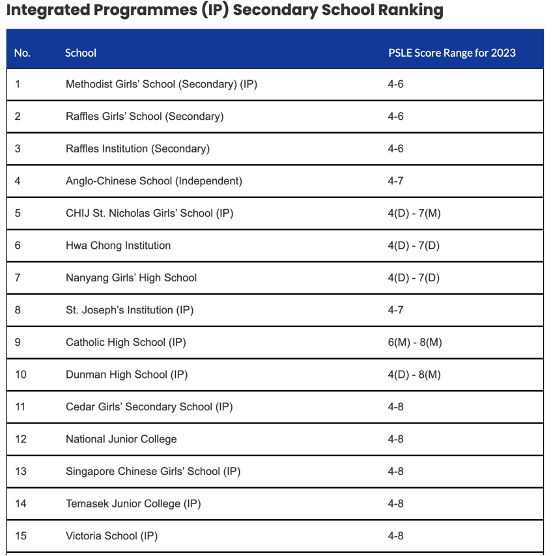
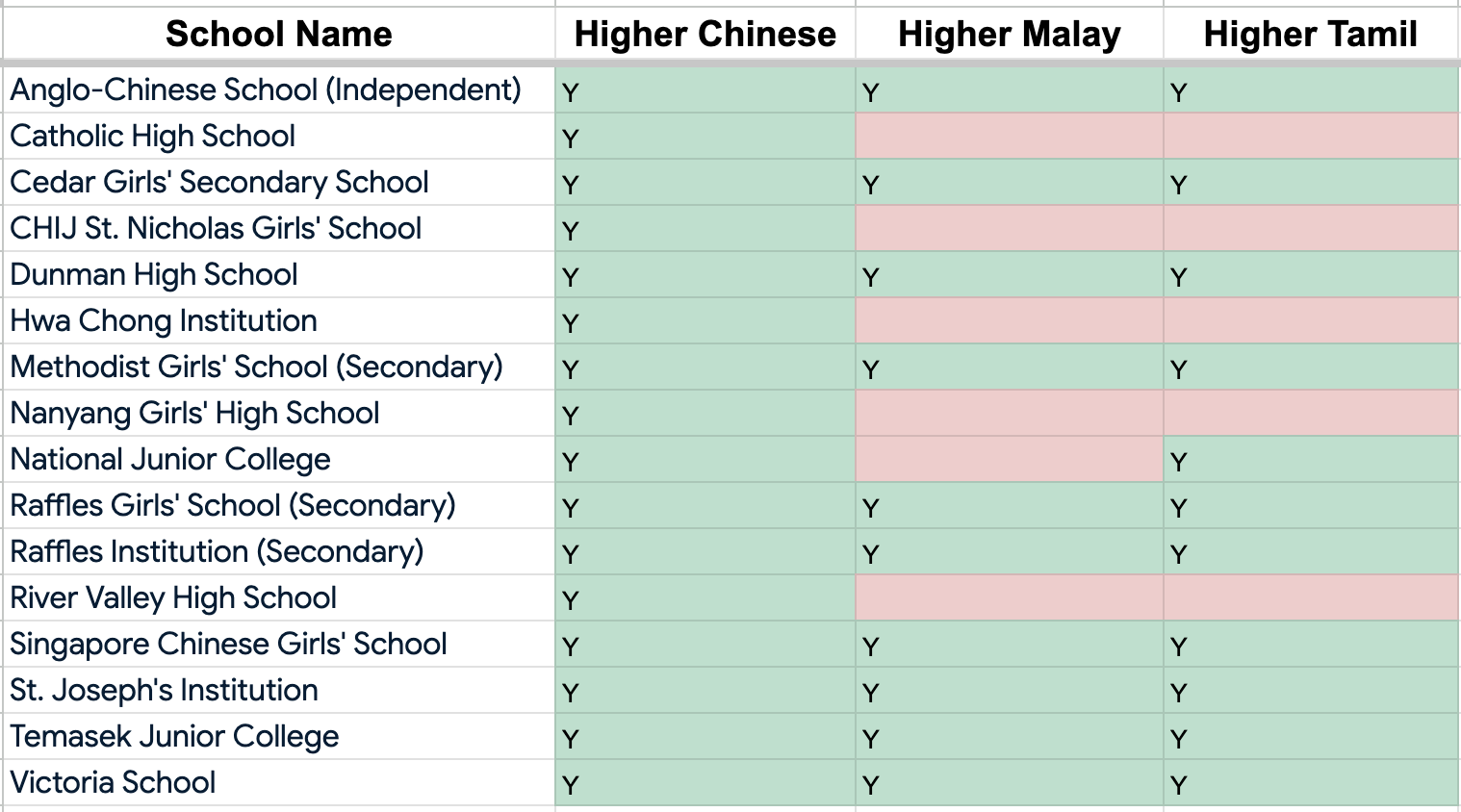
If we were to attach some significance to testing scores as a marker of good schools, the following list of the top 15 secondary schools here might not shock us (as of 2024). Any Singaporeans will know, however, that of these schools, more than half of them are stereotypically bad at Chinese. And that statement itself has a problem: Chinese is the only real language we consider as part of this elite circle of bilingualism, not Malay or Tamil. Perhaps one might argue it is because of under-resourcing, but also perhaps because our elite circles are heavily racially biased. If we take a look at the rough distribution of Higher Mother Tongue offerings in these schools, it is clear that Chinese is overwhelmingly more accessible at a higher level than other languages. And this is not even looking at the actual numbers of students taking these languages – those statistics are not publicly available – or the actual performance of these students. Then, that will really reveal the weaknesses in the real execution of the Singaporean brand of bilingualism.
The dominance of English-speaking elites is also a product of parents looking down on Chinese. My mother had many experiences with the sort of derision and contempt many Singaporean parents have for what she teaches. Back when she was a secondary school teacher, it was obvious in how her school used to treat the Chinese Language department. Now as she works as a private tutor, the brusqueness of some households who hire her purely to ensure their children’s transcripts are not tarnished by a bad Chinese grade communicate this same attitude. All this is to say, that Singapore’s language learning infrastructure, both policies and intangible culture, was ill suited for making me enjoy learning Chinese. I imagine that this experience with language is not unique for many Singaporeans.
My love letter to language learning
This brings me very nicely into discussing the two most unpolished languages in my tool box, but also languages I have come to treasure for the reflections they have given me. Japanese and Hebrew are different enough so that I don’t really get confused between them now that I am learning both concurrently, but it is a challenge when I am reaching for a new vocabulary. New languages reside in the same mental bucket separate from our native languages, and that process of recall feels very similar. Sometimes, the Hebrew word obscures the Japanese equivalent just because it is more familiar or recently used, and I have no choice but to reach for Google Translate.
I have also found them to be very different because Japanese is a very high context language whereas Hebrew is a low context language. High context refers to the importance of tone, context, and gestures, in understanding the language, whereas low context languages usually rely on the words only. I had survived three years of kendo without any knowledge of Japanese, and I felt like I perfectly understood the Japanese senseis because of all the contextual clues. Hebrew, on the other hand, feels very unforgiving when you don’t know the specific words used, and I have a hard time trying to guess correctly what an entirely foreign conversation is about. I think that many potential confounders are controlled for, because both of them are very fast spoken languages, have more syllables than associated meaning, and have quite a few conjugated forms for verbs and adjectives.
This makes for very different learning experiences. By virtue of Chinese being my mother tongue, which is very high context based on the amount of homophones alone, I have an easier time learning Japanese. This also creates a learning habit where I learn faster when actively using words and phrases in its context to understand and remember them. Immersion and the spoken part of the language becomes more important. I think that is why I struggle with language learning programmes like flashcards and Duolingo, because I don’t hear the language, and my mouth doesn’t taste the shape of the words.
If everything seems to point towards a harder time learning Hebrew, why do I still do it then? I think that its low contextness is actually really important for innovation and showed me a completely different perspective when it comes to meaning creation. Hebrew words matter so much more than the context because the words themselves are so valuable. Most modern vocabular are painstakingly created via association to the few words used in the Bible. For example, tipping scales and justice are expressed with the root word for ears, because ears are what gives us balance. Or for example, a picture is based on the root word used in the phrase “image of God” in the Bible since it is a creation in likeness. The creativity of the language is so much more obvious in Hebrew. If language is a way to view the world, then Hebrew has given me new perspectives to consider my relationship with the world.
Language learning is also ultimately an exercise of empathy. I’m sure that even if I lose all my fluency in these two languages, they have strengthened my ability to empathise. On the most superficial level, I learn to not get annoyed, at others and myself, who say or do something incorrectly. I know what it’s like to have an electric board all plugged and connected to the wrong places with the wrong lightbulbs going off. I know that eloquence is secondary to communication, especially if I am a native speaker of that language. If someone struggles with an inappropriate vocabulary, or with improper pronunciation, or with poor grammar, but I can ultimately understand them, that understanding is extended unconditionally and without expecting them to apologise for the mistakes. Instead of demanding for perfection in expression, being charitable makes us all better communicators.
If language is a way to view the world, then this empathy reaches even deeper than that. Hebrew, for example, is a language that cannot disentangle itself from its Jewish roots, and religion is central to understanding it. I come from a secular family, secular education, and probably don’t have a single religious fibre in me. Trying to understand the framing of certain words, how issues are perceived, and how Hebrew speakers think about the world is immensely difficult. And I have learnt that such difficulty often deters empathy. It is therefore even understandable why some people are unempathetic. Instead of griping about the unempathetic nature of our society, an endeavour that demands the effort to learn a whole new language, all I can do is to remember to write with all the perspectives of the languages I know. And to love this difficult process, always.
 Updates
Leave a comment