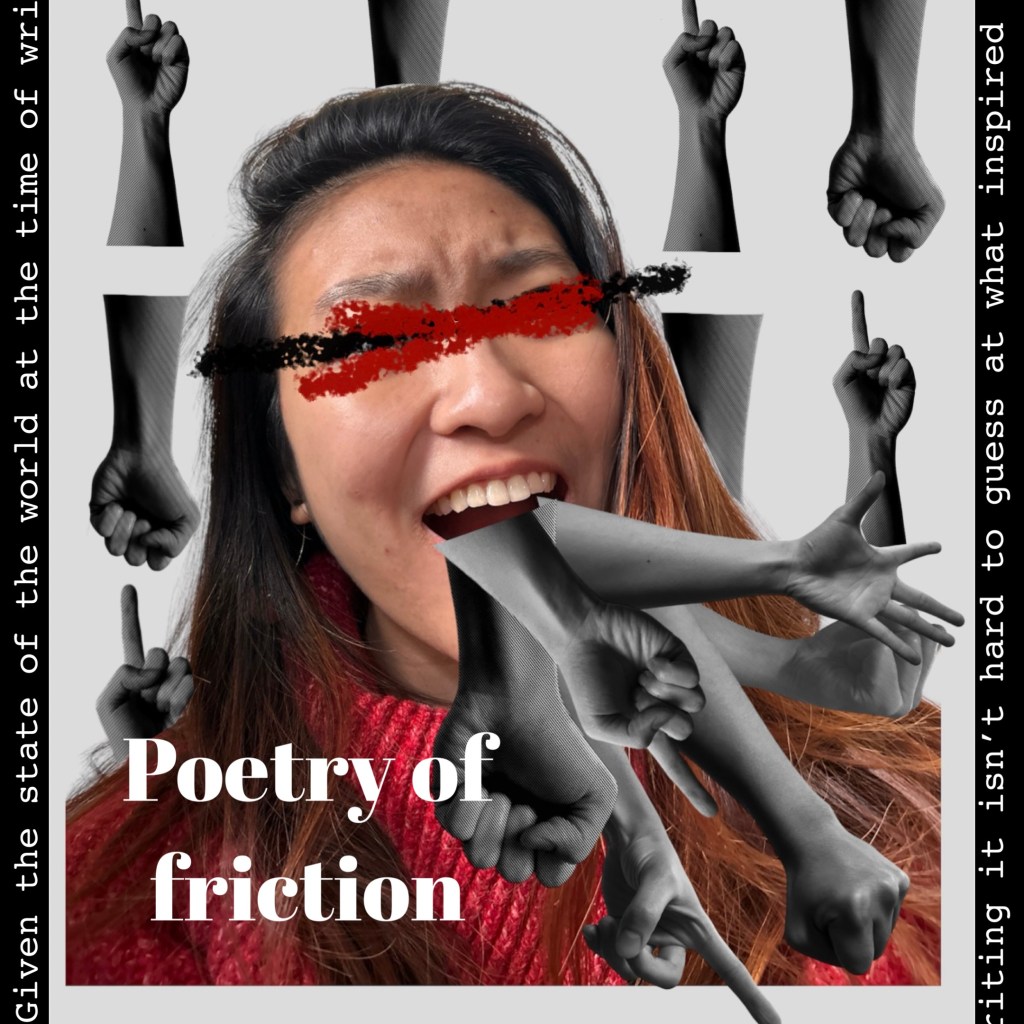
Given the state of the world at the time of writing it isn’t hard to guess at what inspired this piece, but I will keep this reflection strictly sanitised. This is not about me asserting my views on any subject matter; rather, I am entirely focused on the discussion about how dialogue fails in controversy. This disclaimer of self-censorship stems from the thesis of this piece: silence is not complicity and being forced to take a stance is a form of tyranny. Feel free to take that as cowardice, as a typically Singaporean pretence of neutrality, of internalised aversion to freedom of speech etc. I, however, hope that I can provide a less cynical defence of why we keep silent, as well as inspire alternative forms of dialogue for those who are conflict-averse and feel alienated by polarised conversation. I want people to agree with how we can disagree better, and I don’t want that judgement to be confused with agreeing or disagreeing with my personal opinions.
Step 1
The Teaching Fellow for my Central American politics class had interned at Chile’s Ministry of Finance during a year where there was a lot social movements against the very policies he was helping to produce in the office. During lunchbreaks, he would take off all identifiable government IDs and join the student protestors on the streets, and at the end of the hour, he would come back into the ministry as if nothing happened. The incongruency wasn’t voluntary – this internship was a part of his graduate programme. Once, as the protestors snaked between high-rise, residents in those apartments began to drop plastic bags of faecal matter on them. He wished he was as nonchalant as the students were, except he had to stand beside the sink of a public toilet, hand-wash his shit-stained white dress shirt, and scrap together some modicum of presentability before going back to work.
We all live double lives of some sorts, and the tensions between external demands like career or environment and internal beliefs and core values cause all of us to inevitably be a little schizophrenic. Even if the decision seems to be easy and straightforward, actions incur a cost that gets costlier the greater the incongruence. What more to say, in a controversial debate with subject matters that are complex (I detest this cop-out term because it feels like the end of a conversation when people are unwilling to disagree), our individual interests get even more entangled. I myself feel this tension acutely. Being a government scholar is a privilege that should allow me to freely speak my mind knowing that I have a safety net. I do believe that the beneficiaries of a system should shoulder the risks of advocacy because that is the responsible thing to do with privilege. Yet, it is also an incredibly stifling position where strangers are ready to do the most uncharitable interpretation of my words that implicate my organisation, which consists of other people who never consented to me speaking on behalf of them. Unless we are willing to recognise the circumstances that surround dissenters and understand that they are justified in their own actions as I am in mine, an adult discussion is not going to start.
Step 2
In one of our classes on post-truth world, we watched an interview with Lee McIntyre, who lived amongst flat earthers and conversed with them and tried to understand someone who seems, by our own standards, absurdly stubborn in being wrong. When Lee almost convinced a brilliant young man (who was a flat earther) to take a flight over Antarctic to prove that the Earth was a globe, the man balked and came to a new conclusion to reject the offer to change his mind: what if the bigger hoax was that planes needed to land and refuel? That would explain how everyone is kept inside this flat area on Earth! The mental gymnastics involved helped Lee realised that making powerful rational arguments is not the way to change someone’s mind – he needed to empathise with the person who had attached their identity and community to their beliefs. Action and inaction, no matter how irrational, are all a decision borne out of a human need to belong.
In any disagreement, we are speaking to two groups of people: the absolute naysayers, and the fence sitters. If we assume that we engage in discussion because we want to change someone’s mind, even if it’s just by 1%, we want to advocate for ourselves in a way that empathises with these two groups. If your alignment is chaotic evil and you just want to debate for the sake of sowing discord, proceed, and maybe skip this step.
Any controversy is like a taut rubber band – the stronger we lean to one side, the naysayers will exert an equal conviction in the opposite side. Even when we come face to face with our opposites, we rarely are able to communicate well enough to change anyone’s mind (see my Hot Take Series on Roe vs Wade). The effort to be understood far exceeds what social media and online interactions can support. Fighting in the comment section of Facebook and reposting Instagram stories (I would add Tiktok but I’m too old to understand it), are not productive avenues of dialogue. Forgive me, then, for being unwilling to choose those avenues to express myself. People with strong beliefs cannot be convinced to change their minds, unless I myself am willing to concede and change my mind on something. If we are unwilling to admit to the possibility of our own fallibility, then perhaps we should disengage with the opposition and prevent the discussion from becoming ugly and resentful.
As for the fence-sitters – the biggest ideological real estate for people on either side of the debate – I would like to suggest that they are not doing it out of apathy. Hedging happens when we don’t feel like our choice are any different. The “with us or against us” rhetoric is radicalising and unempathetic, and when both sides of the argument tap into this rhetoric, it is a choice between two equally aggressive and overbearing voices. I might rationally believe that one side champions an agenda I agree with, but hostility (even if it is not aimed at me) is an emotion and thus elicits my emotional response and does not appeal to my rationality. I know that when I believe strongly in something (talk to me about meritocracy, or the value of humanities, or sex ed) I find it incredibly frustrating that fence-sitters try to intellectualise their accountability away. However, I also think back to when I am decidedly on-the-fence about some issues (like veganism, or taxing the rich), and empathy goes a long way to make it easier to restraint the instinctive frustration at people who do not immediately agree with us. Disagreements can only be sustained when this spirit of persuasion can restrain our natural emotional response.
Step 3
Harvard recently released new regulations on campus protests and freedom of speech. This restricts the legal locations of protests to a few outdoors, transitory and communal spaces, and generically guards against hate speech. Our student-run newspaper ran an opinion article that challenges these regulations, not because regulations on speech itself is bad, but because these regulations have been unevenly enforced on students who were participating in Pro-Palestine protests.
The spaces that controversial conversation occurs is vital. Harvard’s campus needs to be a safe place for any debate to occur because it is first academic before it is political. That is why I think it is important for regulations to exist to channel divisive conversation into limited and productive avenues. I think any organisation or country should define limits to free speech, but that is another conversation for another time about why I don’t agree with political liberalism. However, I feel that disingenuous enforcement of regulations is in bad faith because it only squeezes dialogue out of the public. Here in the land of the free, in one of the leading institutions committed to Veritas/truth, I feel like the walls have ears, and I am only comfortable having discussions with groups of my close friends. Disagreements becomes more polarised when conversations are forced out of the public and into the private and more homogeneous circles – there, we hardly have a chance to humanise the people who disagree with us. Many in Singapore would talk about the feeling of state over-reach in policing public discourse, but I think it is the same anywhere – censorship comes in all shapes and forms.
I think it is because of the many limitations on physical spaces that online spaces are becoming grounds of contestation. I respect people who repost important information and help spread awareness, and I also appreciate how many people like me refuse to engage with the social media space because I just don’t see it having tangible impact. Trying to out-scream a crowded racket renders my message illegible. I think we can agree that no one would fault a person for using Instagram but not Facebook to advocate for a cause since it is only a matter of form. Therefore, I think we should also agree that using social media for advocacy is also only a matter of form. If it is the most productive and accessible means of dialogue for some, they should pursue it. If it does not work for some, then we should not coerce participation.
The root of the indignation at people’s “passivity” comes from not being able to identify the other forms of action in place of public discussions. We want to see that people are doing something. I can’t defend everyone, but I know that I believe in longer-term solutions, and I believe in co-opting rather than dismantling existing governing infrastructure, and so I am willing to work in a system to follow through on my beliefs. Not all actions are advertisable, and I hope that empathy can help us see quieter people as well-meaning rather than passive.
Step 4
A Russian teacher showed us recreated clips of King Louis XIV dancing ballet as part of the class on history of ballet. Louis XIV was using his body to prove his divine right to rule, but he hardly moves or dances. She tells us that royalty do not mime or dance – that was for the peasants. She says, monarchic rule is about display, not the interlocution of democracy.
Silence is not complicity. Should dialogue fail despite the best efforts in the previous steps, it is perfectly acceptable to learn to be silent. I make this claim knowing full well that there are occasions where bystanding is as terrible as participating in the bullying itself. I acknowledge that there are numerous occasions where dictators use the implicit consent of silence to repress. However, those are occasions when silence is abused. Inherently, there is nothing wrong with choosing to stay silent, and I think the current climate that demands everyone advertise their stance wrongly characterises muteness as a negative thing. I would even go as far as to claim that in especially controversial debates, silence is much more powerful than shouting.
Firstly, not challenging the association between “speaking up” and being inherently good can cause advocacy to devolve into performativity. I think a portion of my allergic reaction to speaking up stems from my distaste for virtue signalling. I am not accusing everyone of virtue-signalling when doing advocacy work, but there are enough bad apples whose actions inspire disgust because they attempt to police other’s speech while they rest easy knowing that no one is willing to police their insincerity. We all have good enough judgements to tell when someone is being disingenuous when fulfilling the sole requirement of speaking. Talk is the life blood of democracies, but at some point it slips easily into just show, and parading about in conversation becomes as out of touch and gaudy as King Louis XIV.
Secondly, silence is an integral part of advocacy, and it should not be used as a rhetoric to arm-twist people into saying things. In order to speak up about one headline-grabbing controversy, other injustices need to be silenced temporarily – it is ludicrous to expect us to be on the hamster wheel of moralising non-stop from #MeToo to Rohingya Genocide to Ethiopia’s Tigray conflict to Singapore’s definition of marriage to Harvard’s presidential turnover to the ongoing child labour abuses in the cacao plantations to the etc etc. The world is big enough for many bad things to be happening at once. Conversely, it is also big enough to pay attention to many different disagreements without distracting from one another. The takeaway is not to throw our hands up and stop caring about the tragic state of the world; it is to recognise that silence is important for us to talk about issues we care about, and we should not penalise one another for that. There is something wrong when of the three options (to disagree, agree, or no comments) the only “right” action to take is to agree with you.
Lastly, silence is a justified form of resistance when we know that speech itself is fuel to the fire. Keeping quiet out of fear is not entirely selfish when we witness how speech itself has turned into weapon. Polarisation around controversial topics occurs because both sides of the narrative (and again, it is a false dichotomy that radicals want us to believe because there are never just two sides of the story) use our incendiary speech to promote information warfare. Speaking out in defence of any rational reason or out of the goodness of our hearts becomes co-opted by more powerful figures in spreading their narrative. I am a bit more of a cynic in this regard because I think we are all just pawns manipulated by the illusion of agency with the “fighting back with our feeble voices through the power of the masses”. In such a case, and especially when we have reason to believe that behind-the-scenes there are politics and state powers that far exceed our imagination, silence is the best form of resistance.
Step 5
In my Hebrew class, our teacher brought in Netah, a musician in the multi-national and multilingual band – System Ali. They use a myriad of languages like Hebrew, Arabic, Yiddish and Russian, and work with rappers from all extremes of all ideological axes. I came into it hoping for an easy feel-good ideal to point to: look there’s a successful band that shows music’s unifying power between Israelis and Palestinians! In reality, he shares, the creative process borne out of diversity inevitably creates train wrecks, clashing not only in rap verses, but also in fist and knife fights. The reason why things get heated is because everyone brings their verse to the table, and in Hebrew, verse shares the same word for Home. That is something worth fighting for.
Inevitably, as with any controversial subject, the rules of engagement cannot cleanly separate itself from the subject matter. To avoid being side-tracked, I will just say that regardless of anyone’s positions, regardless of any animosity towards people we disagree with, it is a deeply human desire to seek unity as a solution. The unity looks different to everyone, and we might disagree with the outcome, but the core motivation is to agree. No one wants to disagree; that is why we debate in the hopes that we can come to a majority consensus. Even if you’re a self-proclaimed agent of chaos who thrives off discord, you understand the fundamental psychology behind sowing disunity – that society seeks to congeal around a wound, even if seeking to become whole again causes tension.
People exist behind every disagreement, and the civility of a debate breaks down when we forget that. Intellect does not make us immune to bad communication habits (so many universities are rife with polarisation now); data and facts do not make us any less bad of a communicator (it’s not the scarcity of facts that troubles debates, it’s the abundance of interpretation); the Arts do not save us from the discomfort of disagreement (System Ali highlights that artistic processes are only tools, and like any tool it can fail and be abused). We only get better at discussing controversy if we learn from the people behind each debate. To further belabour the point on humanising disagreements is to insult your comprehension.
Conclusion
Elma Mitchell’s “This Poem” begins “This poem is dangerous it should not be left within the reach of children, or even of adults”. It first came to me when I was 14, through our Secondary 2 literature teacher who wanted to introduce to us the reality that words have teeth. Nearly a decade later those words describe a reality of the climate of disagreement we live in. No matter how dangerous a conversation is, we need to learn to have them, or else we become the very caricatures of Mitchell’s poem, people who cannot deal with complexity and the poetry of friction in our lives.
To the people who are sitting on the fence struggling to describe why you feel the way you do, I hope I have vocalised some portion of the mixbag of fear and indignation. I hope I have also encouraged you to consider how to be less afraid of disagreement in dialogue, and therefore convinced you to take part in and create conversation in your own way.
To the people who were baited into thinking I was going to fight for a stance, I hope I have given you pause to consider not just the content that you pour your passion into, but also the way you engage in conducive dialogue rather than alienate others from it.
To wrap up finally, I will surface one last disagreement – an objection to my entire piece of writing so far. I am writing about controversial topics and the debates around it, but I might be wrong in framing it as a debate. To have a point and counter-point, pro and against, is to assume that they both merit equal attention. I might be wrong in calling some discussions debates when really they are facts that are not up for discussion, and in my pursuit of “objectivity” I have platformed simply wrong ideas. Many journalists make this mistake: think climate change debates, where the minority of climate change deniers are given the same visual weight, airtime, and representation as almost the entire scientific community, which disastrously brought us to present-day policy confusion where we refuse to condemn any opinion. I am open to being wrong, so this is an invitation for a conversation around how to disagree, and perhaps when the norms have been negotiated, we can move on to talk and disagree about all the other things happening in the world.
 Updates
Leave a comment