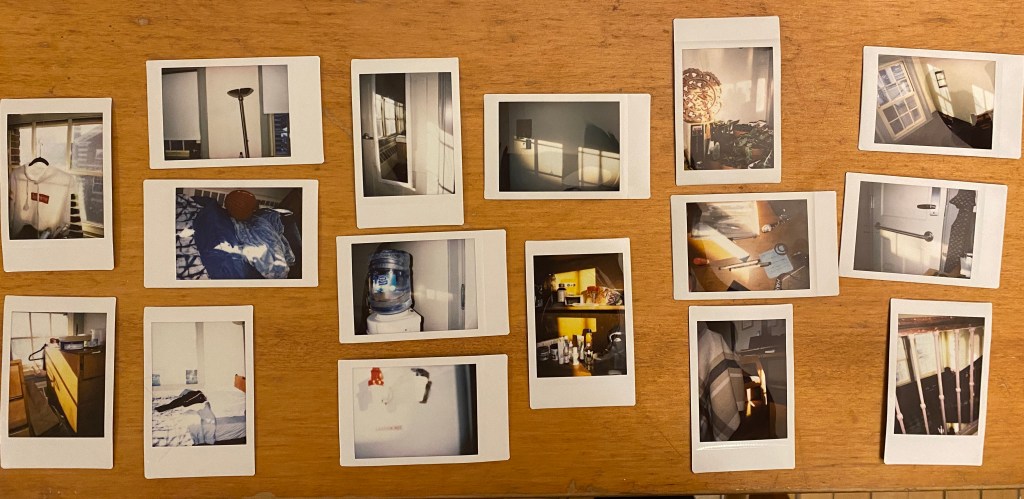
As a child I would, on my small blue-lined homework notebook with translucent pages, design a room I would live in. It would have three walls, a chandelier, a window, a bed, and other banal detail I have already forgotten. I would erase it and draw again, and again, until the smudges of lead are bad enough to upset me enough to give it up, or the pages tore apart from the erasing.
I never had my own room – now that I reflect about it. No bedroom to decorate with my own cringy teenage sensibilities, no door to shut. I have been doing communal living for my whole life – with my brother, later my mother, then the army, then now in college dorm. No wonder I had always loved Ikea shopping, winding through their room displays, paging through the glossy catalogue full of Scandinavian sounding names and pressing the spread to my face to inhale the scent of that highly specific type of ink and paper Ikea uses. From my mother, who would flip through these catalogues and dog-ear entire pages, I had inherited a love for the fantasy of private spaces.
“For our house is our corner of the world. As has often been said, it is our first universe, a real cosmos in every sense of the word”
During my painting class, we encountered this reading “The Poetics of Space” by Bachelard, and I thought that many of its quotes prompt certain reflections, both personal and highly academic based on the few courses I am taking this semester.
When I say space, I think many people will instinctively gravitate towards one of the two definitions, depending on what state of mind you are in: 1) a location or 2) where stars are. A house is a universe, “a real cosmos in every sense of the word”, so I thought to first pay tribute to some learnings I had from the astronomy class I am taking.
People who know me would be surprised I am taking astronomy, because I am definitively not a science person, but increasingly I realise that astronomy is honestly more like an art, the way things like particle physics feels like an art. It is rooted in equations and scientific methods, for sure, but it has that reverence for human insignificance that I think is a deciding line between the Sciences and Humanities. We are not only a trivial existence in space, we also know so little about anything for that matters. What are we to make of our understanding of space when only a mere 5% of the universe is made up of matter and the rest of it is made up of undetectable dark energy and dark matter? Why do we matter (pun intended)?
Furthermore, there is a rather liberating freedom when most people think astronomy is hardly applicable to their lives. Who cares what new planets we found? Or how far the stars are? Astronomy has the sense of “impracticality” or “triviality” that people accuse art of (or art itself feeling compelled to defend itself against these accusations). I say it is liberating to be accused of the lack of practicality, because too often our society demands instrumentality and utility from us – the allure of computer science perhaps. We had a lecture today about Zhuangzi’s philosophy, and he tells a story about how a carpenter looked a crooked and gnarly tree and accused, “You are useless to everyone.” To which the tree replied, “Perfect. It is because of my uselessness that I survive long enough to become such a big and tall tree.”
In such a world that demands us to justify our utility, perhaps a house, our corner of the world, should shelter us from it and give us space to do what we want. Even if it is a figurative house we build in our “trivial” academic disciplines.
“The house shelters day-dreaming. The house protects the dreamer”
In a more political sense, a space of our own protects a lot of our dreaming. In that sense, a room protects an intensely private sense of self. In a class on Middle Eastern politics, many political scientists have argued that it is the lack of private property that caused the region’s tendency towards authoritarianism. Firstly, a lack of privacy makes it difficult for civil society to organise themselves, especially in highly repressive regimes, because it creates barriers around people’s interior worlds even if they share the same roof. There’s a Syrian wisdom that goes along the lines of “whisper, because even the walls have ears.” It is unimaginable for many people to think of a house with no privacy, and I think that is the essence of what enables us to dream.
Secondly, no private property means a tendency towards a strong state, because there will be no land-owning class to provide a challenge to the government in order to protect the stakes in their land. Property is power. It is a tangible manifestation of an interior space we can defend as our own. This logic does not elude us for long – as children, we learn very quickly to retreat into our own rooms to stew in some childish outburst, or as an act of rebellion against our parents, or to begin to carve out personhood by demanding that people knock and seek permission before entering. We know that space is powerful.
All these political meanings of protection can also be distilled into more personal experiences. Virginia Woolf’s “A Room of One’s Own” captures the essence of a space in defending personal identity. A woman needs a space for herself, first and foremost, in order to start to become intellectual equals to men. While there are many women writers who write in the kitchen in the wee hours between when their child goes to sleep and when they have to start the day’s chores, I think it is telling that almost no male writers ever had the domestic space intrude upon their interior creativity. In fact, the feminist argument in “The Creation of Patriarchy” by Lerner suggests that the reason for male dominance in many ancient societies was because of their possession of private property, not because they hunted for food etc. The argument goes that through creating and defending their own houses, men build a family which demands for monogamy, allowing them to start to control female sexuality, leading to our patriarchy today. Again, even if we do not care for the political struggles of democracy and autocracy, space exercises power over our gender and personal experience.
“We bring our lares with us”
I have been thinking about what it means to decorate my university dorm room, especially after visiting some really lived-in ones and realising how lacking my room is. Where others have plants crawling all over the walls among the hanging lights, rugs, photographs, I have nothing save a few post-it notes of formulas and reminders. A big part of it is because I have always treated communal living as a very bare space, only for the essentials. Maybe that is the military bunking experience speaking. I look at the tapestries and wall décor and can only think about the practicalities of it – where are they going to go once we leave this dorm room? How can I make space in my meagre 22kg worth of belongings flying to and from my home country?
That is why I started buying plants – in part a commitment to learn to take care of another life, in part an attempt to break out of the habit of treating my room as a temporal residence. Depending on perspectives, any room is a temporal abode, so every space deserves to be lived in properly, not in such miserly fashion the way I did. To live in a sterile house is like living in a workspace, cold enough to freeze our capacity for intimacy.
Why do we not stay in our workplace then, I wonder. This prompted a reflection into what makes a room a home, and why it seems so inhumane to bind us to offices with overtime work. It must be the shining peak of capitalism to seek to maximise efficiency to the extent of reducing the time spent commuting between home and work. However, the past year of work-from-home has also shown that living spaces can infrastructural support what we need in workspaces. It cannot be healthy to blur the literal line in work-life balance.
It comes down to how little control we have over our environment. I probably never will fantasise in my workbook about how my work place desk will look like, because there is something impossible about that notion of invading corporate uniformity. The poetry in space can only be explored when we have a choice in its design (maybe that is why it feels more normal for an artist to sleep over in the art studio than a scientist sleeping over in a lab?) Aesthetics aside, our own room also affords us control over its cleanliness. We can choose to clean it as much as we like, or have it as messy as it suits us. In workplaces, rules and regulations prevent us from descending into uninhabitable mess, and the entire underbelly of janitors remove the need for us to clean. It is also something communal living can never afford, because it is rare to find a roommate who has similar tolerance for mess.
The final, most intimate part about space will be a return to the little blue-lined workbook. We carry a part of ourselves everywhere, and how we visualise and consume internal spaces reflect who we are. It is able to tell us so much about our identity because it is something we can exert control over. Housing day is coming soon, when we get sorted into our upperclassmen houses, so perhaps all this reflection is to say that I look forward to being able to actualise the space inside my head where I have been erasing and reconstructing a room of my own all these while.

 Updates
Leave a comment