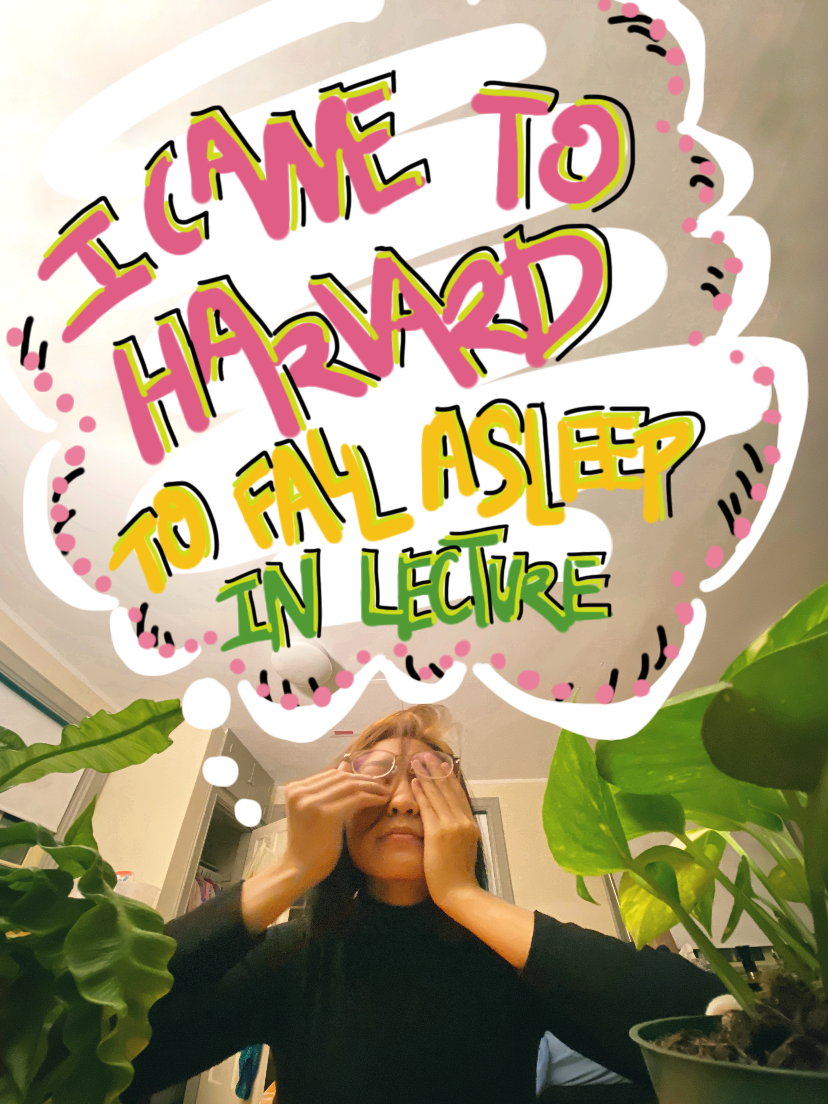
Imagine the audacity of being able to choose your classes to do things you enjoy but still fall asleep in them! That’s what I did for my lecture – specifically the one on political philosophy (sorry Plato and homies) – and I could not believe that I came to Harvard to fall asleep during lectures. Why am I wasting this expensive privilege I’ve been given?
This very recent phenomenon concerned me deeply because I never sleep in class, not in school, not in the army. So, I pulled the plugs and tried everything – I sat in the front row, pinched myself, held a mouthful of water in my mouth the entire time – but nothing worked. I still dozed off, much to my embarrassment, in the first row, and there were words on my notes that had tripped over each other like drunkards and were beyond comprehension. The only redemption I had was that at least we were all wearing masks so if my mouth was open it was hidden (actually that is one of those small blessings of wearing a mask – no more teachers getting offended by our open mouth yawns). The professor did not deserve the disrespect at all. He had started off the semester with a joke about how there were only 1 in 100 students who were actual students, and I felt like I let him down by being the 99%.
Why our attention span sucks
At first, I had tried to rationalise with myself. I did not have enough sleep; philosophy just ain’t my thing when I barely understand the reading and consequently, I am disengaged; the lecturer was soft and numbly and I had to strain to hear him even in the front row…Excuses were abundant. What else could have explained my abnormal behaviour? They kept the accusatory voices in my head at bay for a while, until I realised that these were all factors I cannot control (well, except for the sleep deprivation one that’s on me) and it seems so defeatist to believe that I have no more mastery over myself. I want some answers about things I could control and improve. I went to Google to find some solutions.
It is time to rethink what we mean by attention. Staying awake? Seems like a really low bar, because even in those few lectures I did manage to stay awake I would zone out too. This is critical to understand before we start guilt-tripping ourselves/normalising inattentiveness. Many of the research into attention span that suggests the rather dismal trend of our shrinking attention span – the oft cited statistic of our 8 sec attention span being shorter than a goldfish’s – refer to a very different thing than the kind of attention I am concerned with. This article reveals how content generation is affecting our engagement with trends, but I wonder if we really are inhabiting the role of an average Twitter user when trying to learn? .

I think these statistic and measures of attention is much more relevant to digital consumption when we become mindless zombies scrubbing through Youtube or Instagram, and that is not the kind of engagement I am using when trying to focus during lessons. Even then, 8 sec is barely enough for us to respond to a friend’s text or reply coherently to an email. Don’t you find it weird how you could be totally immersed in a book, or play games for hours, but cannot apply the same effort to lectures? Surely there must be different ways we engage with information that demands varying types of “attention”.
In this interesting paper, it reveals with how the common consensus of a student’s attention span being 15-20min (that is why TED talk limit is 18 min, a nice average for audience attention) are rooted in flawed research methodology that confounds what we mean by “attention”. Note-taking, memory retention, and body language are indirect ways of inferring attentiveness, but their correlation is not causation. Note-taking and memory retention are very much proportional to the content of a lecture; when my professor just starts narrating the book and I have no “skip recap” option, my pen just stops, regardless of whether I pay attention or not. An interesting phenomenon I observed while being an instructor in Artillery is also that those who write the most notes don’t necessarily remember the most things – it is the curse that writing is an invention that cripples our memory faculty which Socrates bemoans.
Read the paper if you will, it’s pretty interesting and I do not do it justice by trying to summarise it here. What this means is that firstly, the methods to stay focused that I had previously employed are ineffective and doomed to fail, second, that pedagogy matters and third, the solution to our inattentiveness has to accommodate our need for breaks.
1) In light of how note-taking and other indicators inevitably expire by a certain time, trying to write notes, engaging positive body language etc. are just my attempts to appear more engaged, but does nothing to prolong the duration I actually am attentive. No wonder nothing seemed to work. I am not trying anything radically different, and is still bound by the original limits of my attention span.
2) Modern pedagogical approach is a strong opponent of lecturing. It made me wonder why a prestigious university like Harvard still holds on to old lecture-and-download style lessons, when places like the Training Institutes in the army are pressured into adopting new “learner-centric” and “engaging active over passive” curriculum design. Despite how much we disparage the lecture method, the same paper shows how it is good for introducing new concepts when comprehensively organised and convincingly delivered. The value preposition of lectures is the ability to clarify doubts, and it adds up in my experience: I was most successful in sustaining attention when the professor clarifies what the hell Aristotle meant in passages where the English became an impediment to my understanding. In this interesting defense, lectures also train our active listening skills – a skill many students lack nowadays as we focus more on discussions. By learning to listen to what the lecturer is trying to say, it provides me a way to listen and understand difficult texts.
This is, however, not my defence of the lecture-and-download pedagogy, because it clearly has its many unsuccessful parts that puts me to sleep. The lecture is so entirely dependent on the charisma of the lecturer, so it has much more room for error. There are many other ways to learn that are less prone to variability. This very same class has a section where I hardly ever feel like sleeping because I always feel like my brain has cleared its sinus and I am enlightened, and I scribble down so much notes because such a feeling of enlightenment is always lost irretrievably once I step out and become a dumb unphilosophical person again. Something else helpful in modifying the “stale” lecture, was a professor posting pre-lecture online mini-homework due a few days before lecture itself. If it is in human nature to procrastinate, this mini homework cuts short our procrastination by forcing us to complete enough pre-lecture reading so the lecture isn’t the first time we see the material. All these are ways to improve pedagogy, and let that be all I have to say.
3) Finally, and most important, is the practical solution for all my fellows out there who struggle to stay awake. When we struggle to maintain our attention span, we need a break. This article highlights the way we can engage in mini-breaks (2-3min of using a different part of the brain). To note, using your phone or napping or eating is not a break, it is only a distraction, and a brain after distraction will find it much harder to refocus again – perhaps that is why sleeping in class hardly seems to make us less sleepy afterwards. I tested out these short “intellectual breaks” by thinking about dance routines (thanks to the advice of one of my friends) that uses vastly different parts of my brain than the one engaged by listening. Outwardly it seems like I am daydreaming, but trying to recall steps, visualising how to move my body, or how to count certain beats in the music are all really effective. Within the 2 short minutes I was actually much more ready to focus on the professor again.
Other potential ways to take “intellectual breaks” I could think of would be to memorise some numbers (pi maybe?), or go through the multiplication table, or play the 7-up game (where you count from 1 to 100 and skip any number that contains 7 or is a multiple of 7 by saying “up”) or its multiple variations (6-up, 8-up?). For those more musically inclined, maybe think about a particular tune and how to play it on an instrument. Those who play sports, think about a tactic, or an adrenaline-inducing moment, or a technique. Almost everything else we do in our lives activate a different part of our brain than listening to lectures. The only caveat is to not get too absorbed in this break and it ends up longer than 3 minutes. This same tactic applies to trying to be productive doing homework too.
Longer breaks when we have the luxury to do so should last 15 minutes. It should be something that shocks our senses. If we have been listening and staring at the slides, maybe engage smell or touch or taste. This could be using strongly scented hand sanitiser, going through sharp temperature transitions (move from an air-conditioned hall into the hot outdoors, or in my case, from the stuffy classrooms to the chilly outdoors), tasting something really bitter/spicy/sour. A lot of these are the founding principles of advice such as – eat a spicy breath mint, stand and stretch, and pinch yourself.
All these solutions are of course predicated on the assumption that you are not already sleep-deprived when entering the lecture. The few times I slept much later because of bad decisions, I could not keep my eyes open no matter how many tactics I tried. The root solution is to get enough sleep, and for some reason that is a luxury for students.
Intellectual masochism and Stockholm syndrome
Enough said about attention. This entire falling asleep thing also affected the way I view this whole liberal-arts intellectual freedom education I have chosen. It got me thinking about how I could take more ownership of my learning, in ways that I have never done when I was just on an inevitable 12-year mandatory education.
There was always the voice that’s asking: Why not drop the course and pick another one I like more (and is more likely to stay awake in)? To anyone similarly enduring the suffering that is studying, just know that having a choice in what you study does not make you a more attentive student. The romanticized idea of being motivated and excelling when studying your passion neglects the fact that it’s the habits and attitude that makes you a good student.
I’ve stubbornly held on to this class though, trying to prove to myself that I had some greater virtue of intellectual resilience. Just as how I should not be a fussy eater, there is always value in learning outside of our intellectual pet topics and consume a balanced diet for the mind. There should be value disciplining myself into doing what I don’t like.





This is intellectual masochism at its finest, and it is so out of place within this liberal arts education I am in. I mean, the whole point of being able to choose lessons I am passionate in is to not have to force myself to study. However, I am resisting the easy way of getting out of this sleep-inducing class, because I can’t help but feel that this “add and drop whatever you want” mentality somehow feeds into the problem of echo-chambers, where we self-select what we want to learn about. Education will stop being the great liberating force that opens our minds to the world when we end up using it only to reinforce prior intellectual boundaries.
Furthermore, it is easier to criticise rather than try to salvage learning moments from difficult moments. Charitable treatment helps us learn the most from any situation, and this was something this philosophy class taught me. We’ve all heard of critical reading, yet this was my first exposure and practice of charitable reading, where instead of trying to critically engage with the writer’s idea we give them the benefit of the doubt and engage with their arguments at its best. We practice charitable reading when dealing with the flawed ways Aristotle justifies slavery. We don’t give charitable reading enough emphasis even though it is the very foundation for a critical approach – how do you criticise without listening and understanding the strength of an argument? Similarly, how can I criticise the teaching meaningfully if I am to dismiss and disengage with the entire curriculum. This is the whole “university learning happens outside of the textbooks” spiel.
Somehow, the perseverance actually paid off, because spoiler alert: this philosophy class actually became my favourite class by virtue of it being the most intellectually challenging and fulfilling one (Stockholm syndrome who?). Engagement comes from a good balance of motivation and difficulty. Keyword: balance. While I like being challenged by philosophy, I do not imagine myself enjoying the challenge of a hard math class. That difficulty is so insurmountable it’ll probably kill me and whatever respect I have for the subject.
That is not to say I have stopped falling asleep in the lectures. This paradox of being the one class I have trouble paying attention in being my favourite class made me reconsider how I was berating myself for being “ungrateful” for this education. We are supposed to feel lucky that we have access to good education. Growing up in the elite school system it is hard to find that gratitude because we have been spoilt our whole life, and many of us are probably familiar with the whole pressure and expectations to maximise our education. That’s why I am feeling so guilty about falling asleep at Harvard. That’s something I want to re-examine.
The hand in the candy jar

There is this nice little fable, about a kid who reaches inside a candy jar and grabs a handful of candy, but realise his grabbed so much his fist got so big he cannot remove his hands from it. In order to get anything at all, you have to only take a fraction. That is how I saw trying to maximise my time at Harvard, or life for that matter. I fell asleep during the philosophy lessons, but the places where I did put in effort and pay attention, I learnt so much from the wealth of wisdom in this academic canon. That is the tragedy the writer or lecturer has to bear with, that sometimes it is not possible to completely impart all the painstakingly organised and crafted wisdom to us. There is a bottleneck in the jar – our brain capacity, or attention span, our limited time and energy.
Instead of feeling the pressure to maximise everything from our privilege, I am trying to adapt to the mindset that learning something is better than learning everything. I’m in no way trying to excuse falling asleep in lecture, but if I do, or in any other way fail to pay attention, it is not an indication that I am ungrateful or not driven. Learning from lecture is sort of like reading these philosophy books from great thinkers – do I get what they are trying to say half the time? No, but the few instances I see an a-ha moment, or when the combination of lecture and section helped me see some connections, I feel sufficiently enlightened and all the effort in reading the books did not go to waste.
Life is like attending world-class lectures or reading “great” (quotation marks because who gets to decide what great canonical works are) books. I certainly did not come to Harvard to fall asleep in lecture, but this experience has given me much to think about in taking ownership and being more conscientious about my learning. It is not possible, nor important, to get everything out of it. Learning is a candy jar with a narrow neck and we must not be greedy children.

 Updates
Leave a comment