Recently I came across one of those rare videos on Youtube that made me stop and think. The video explains how veganism will not actually help the environment as the Vegan Extremists (VE from now on) would like you to believe. The main method of argumentation is to contextualise statistics that the VE misrepresent, and through attacking the feeble legs of justification, it toppled the whole “eat less meat, save the Earth” argument. Go give it a watch, seriously, if not to educate yourself on the issue at least to see the way they put forward convincing arguments: https://youtu.be/sGG-A80Tl5g
I hope I am speaking for a good majority when I say that I was always under the impression that the VE have very scientific points to back up their hard press for people to cut out meat, specifically for environmental reasons (things like personal health, or animal cruelty lines of argument are very subjective). Even though I might not be convinced to give up animal-based products myself, or I might not agree with their extreme methods, the general notion that “cows fart methane and eat our food therefore bad” seemed sound. There’s statistics backing it up, and we were taught about it during our Urbanization module in Geography. What watching that Youtube video made me realise was that I might have unwittingly been inside an echo chamber where my sources of information are all overwhelmingly one sided. See the following pictures of my Youtube and Google results – how much easier it is to be recommended information that corroborates this notion.
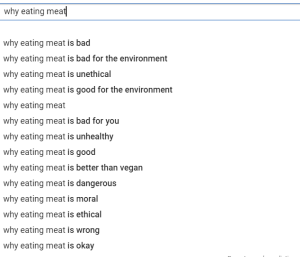

Without going into the details of the counter-arguments (the video can do a much better job at that), I think this highlighted the potential issue of being inside an Echo Chamber, hence the importance of sourcing for objective information. For the few research papers I had to write, I used to craft out my main outline, then plunk in my thesis into the Google search bar and open the most cited scholarly articles. Not only have I just rigged my own evidence by cherry picking what I come across (obviously everything will be supporting my thesis), I have also fallen into the assumption that what most people read/cite would be more reputable. If everyone sources for information as I do, then the articles that are most frequently cited are the least balanced in viewpoint as people see it as an easy source to abuse to prove their own point. Finding balanced information goes beyond just searching for the anti-thesis. See the following image, where even deliberately trying to find contrasting evidence for “balance” backfires.
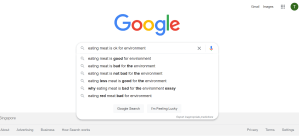
This made me realise how easy it is to manipulate statistics by simply altering the context. There was this one quote that I have never really understood. There are three types of lies: lies, damn lies and statistics. Numbers are held hostage to how we present and describe them, and this video highlighted how the omission of which sources the water came from, or the characteristic of land use, could lead to an inflated statistic on the damage of eating meat.
And so, I thought to myself, surely, if statistics could be manipulated to seem convincing for the VE side of the house, then the same risk is present in the statistics that this video uses to convey its point. Youtube immediately recommended me this video, which engages with the first video I have watched and provides an alternative perspective: https://youtu.be/G44CDBdC8CA. I had to withhold my scepticism simply because the Youtuber is a vegan and already comes from a place of biased fact-finding, but he does raise some valuable points. For example, the use of global statistics where it benefits them (irrigation water usage) and US statistics where it does not (methane emissions) is unfair because you’re comparing very different environmental profiles on very different scales. For example, pointing out that the papers they cited were from animal agriculture sources where there are potential conflicts of interests for them to defend the industry.
This took me a step further because it highlights how statistical manipulation is present in all sides of the argument. If I’m not careful and after watching the first video decided to take that as the truth without verifying the accuracy of their evidence, I’m not any better than the VE because I am only standing on the other extreme of the spectrum. One has to agree though, that the first video is a lot more convincing simply because of its presentation, where there are visual aids and cool editing vs the second one where it is just a guy speaking straight to a camera. Goes to show that the ease of understanding and consuming the argument also plays a part in manipulating our impression of how convincing it is, and we should be careful of this inherent inclination when trying to come to a decision on our own stance on the matter.
One interesting side note is that the comment section for the vegan guy’s video is just one whole massive Echo Chamber. Go take a look at it for yourself, at people completely dismissing the points raised by the original video, at people waiting for him to rip into the video and show them how wrong it is to think that eating meat is ok, saying to leave a link to his response video in the comment section of the original one etc. Hilariously ironic for the VE, because it does not help their cause. Without trying to make a balanced argument, they’re not going to engage and convince the omnivorous majority to see their point. Also, in a rather petty move, the vegan video did not link the original video that was being discussed in his own description box, which was stuffed full of references which support his own points.
To wrap this discussion up, statistics are easy to manipulate and deserve to engage more with our scrutinising faculties. I think it is also hilarious how the original video’s final call to action is that we should stop buying into “cows fart methane and eat our food therefore bad” and target food waste which would more substantially reduce the impact food has on our environment #savetheEarth. This is exactly the end goal of all the VEs – to make a difference to the environment in their food choices. There is no conflict of interest. They both have the same end goal in mind, the only difference is the road they choose to get there, and the VEs being caught up in their own Echo Chamber, has failed to see the allies they could make. That is the true danger of being caught up in an Echo Chamber.
 Updates
Leave a comment