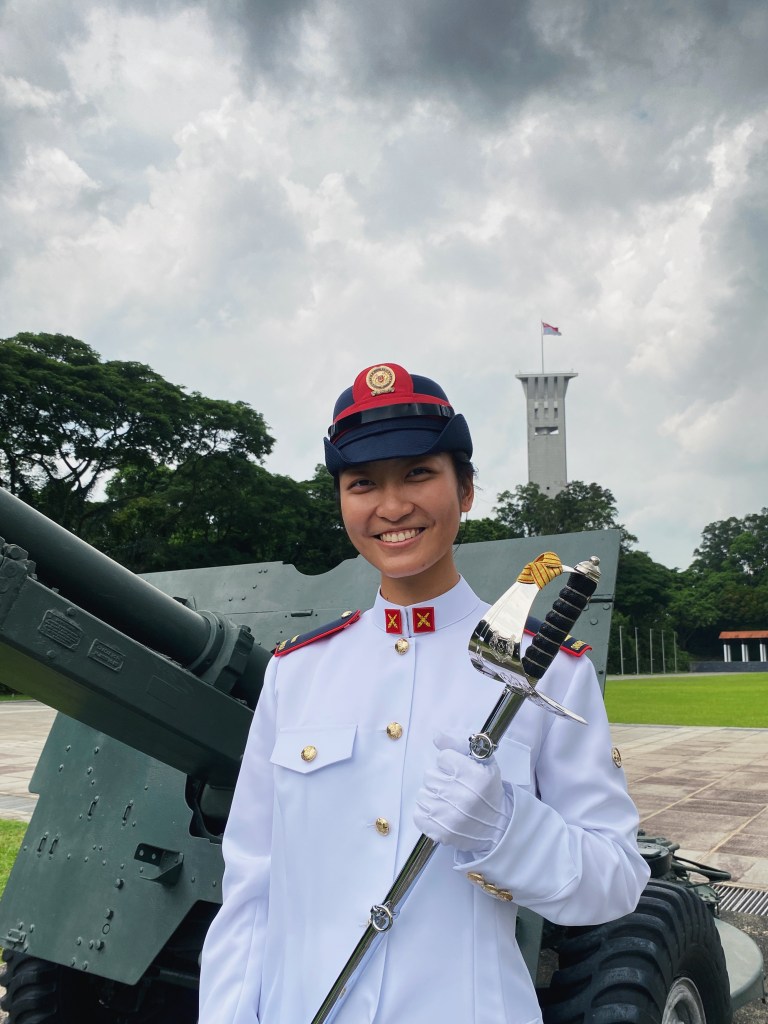
You never realise how nervous you are until you are forced to stand completely still and every nerve is dying to jump out now that fidgeting as a distraction is not an option. I was confronted with this fact while facing the officiating officer during commissioning ceremony, with so little preparation, that I could do nothing but to pray that people cannot see the way I was quaking. My back and arms were twitching completely without my control while standing at attention (I tell myself it is from the exertion and not the nerves), and I was sure the white gloves only emphasised how my salute trembled like a leaf.
Why was I so nervous? No matter how much I tell myself it is the strain from standing with rigid posture for so long, I could taste the chattering of my teeth. I was terrified of what comes after this. I was terrified of how I am unable to, and unwilling to, run away from this thing that is causing me distress. This is what it means to carry responsibility, and somehow it felt even more intrusive when we have a private ceremony in the presence of a few commanders compared to a huge parade, where we are afforded the distraction of being anxious about screwing up the performance for the crowd. In the silence and the small audience, we are confronted with a deeper anxiety of “what now” that does not melt away after the performance ends.
Before I move on to unpacking what being bestowed the rank meant, I thought about what it means to win a clean sweep of awards. There aren’t enough words to hide behind humble dismissing words, so in all honesty: I am relieved I have met my own expectations. I thought I should be happier, but the relief of having preserved my ego (I kept saying that it’s an ego thing that I better top the course with 4 months head start) probably washed it out. I am honestly happier that there are friends I have made who seem even more excited about my achievements than I am for myself. As a cadet, there are things that you can afford to stress about only because it has to do with your ego, and will hurt only yourself. I realise, while holding onto everything, that from now on expectations are more than just about me. Sure, there is an element of disappointing myself, but from now on I will be letting people down for having taken an opportunity, or for affecting their lives that will be entrusted to me. Maybe that is why I tremble during the ceremony.
I think back to this video of a valedictorian speech, and how he said that the thrill of having all his efforts pay off upon finding out he has won lasted only for a second, and it’s the realisations after that which defines your effort etc. Again, coming off as a super elitist and entitled, but I realise these awards are more important for other people than for myself, and they lose a little of their value. Many are probably thinking “if you don’t want them then give it to me”, or “some people will never be grateful”, but I think there’s enough cookie-cutter gratitude speeches out there anyways. The truth for me is that if I allow myself to gloat over what I have achieved, I will eventually turn into a mediocre old person who burdens unwilling listeners with stories of my youth and how great I was, only because that is the only high point of my life worth telling people about.
Now, onto commissioning and beyond. We are now the only ones responsible for how we carry ourselves after this. Sure it might reflect badly on who brought us up as officers, but the onus is on us (haha word play) to prove that we are worth wearing that rank. It’s a bit like marriage, now that I think about it: a big and grand ceremony, and for those who treat this milestone as an end rather than the start, effort level will drop and things will only go downhill. I think that there are many people who have been terrible cadets, but will make good officers, and a small minority who are excellent cadets but end up terrible officers. Self-policing is probably the differentiating factor. What’s important is to stick to one well-considered rule of your choice (it really doesn’t even have to be based on competency or items that the system has used to evaluate you), and measure yourself to that.
Something else that stuck with me is how as a contingent commander everyone is looking at you, yet you have no visuals on how everyone is doing and what is everyone going through behind. Someone could have fainted, and even though you don’t know it it’s still your responsibility. The standards of the drills are usually determined by how much each rank and file looks at each other and coordinates among themselves, but somehow everyone is supposed to take cue from you. People can be flipping you off, or there might not even be people behind, and you wouldn’t know. Firstly, I think this is an apt comparison to how it feels like to be an officer now. Many things are beyond my control yet are still my responsibility. Secondly, it also says something about the type of leader we choose to be. We can be the contingent commander, we can be the first guy in the row to lead everyone in, we can be the last guy in the file who can see everyone. We are being trained quite heavily skewed towards that one type of leadership (ie the contingent commander), but from here on out we have a choice to define ourselves and the leadership style we choose. This is the kind of freedom we are afforded, beyond the superficial liberties of no longer marching, OTOT canteen breaks and so on.
Everyone has something different to say about their takeaways from commissioning, and their own expectations of what is to come from here on. We all probably feel our heart thunder and our fingers tremble, and our sore throats from screaming the words we have never meant more than in that moment. And all for different reasons. The downsizing of a parade into a small ceremony, the absence of feeling people’s eyes on you (let us ignore the fact that any mistake is immortalised on video), all leave us facing our own thoughts and expectations, and that is perhaps a silver lining in our COVID version of commissioning. What now? That is a deeper anxiety that will only go away once we make a promise to ourselves.
 Updates
Leave a comment